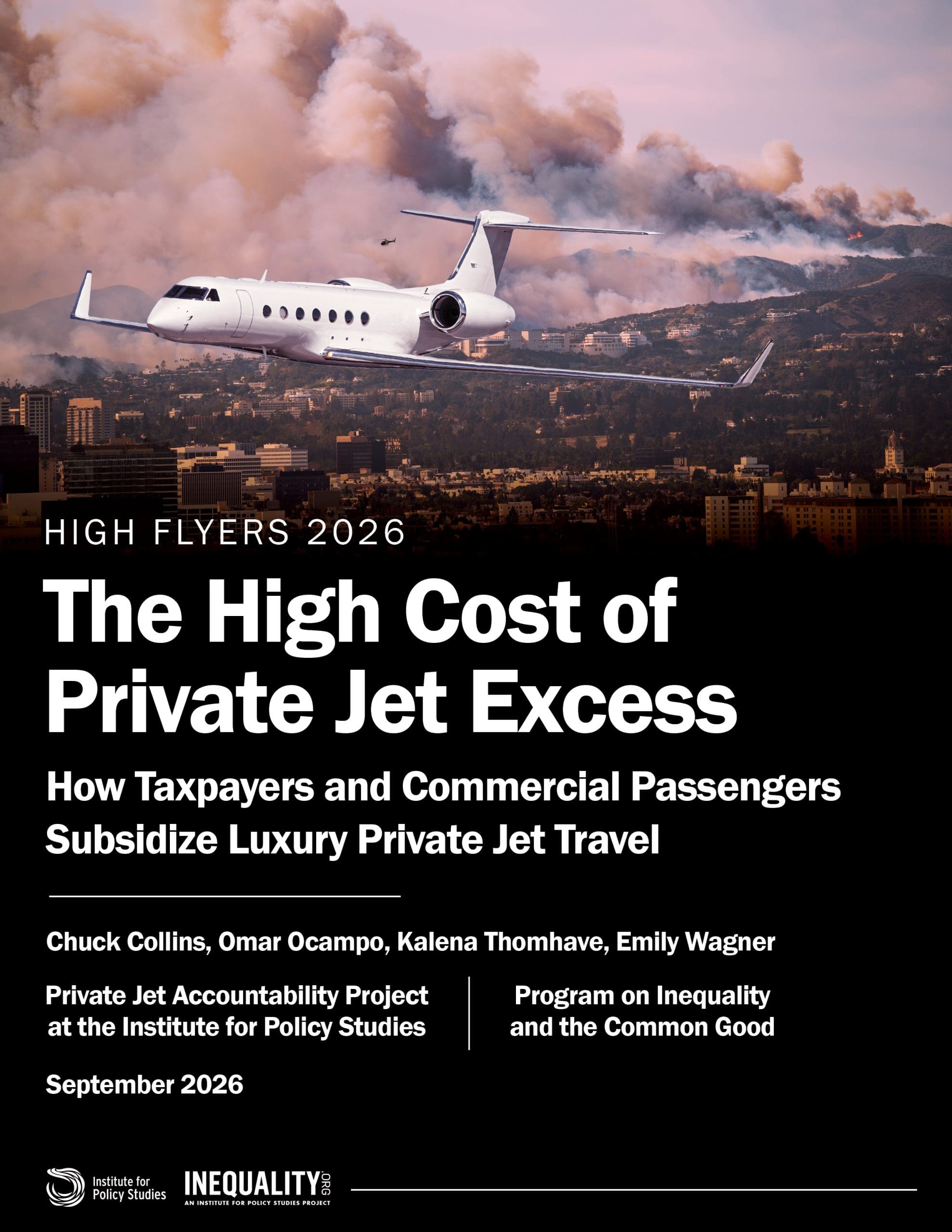
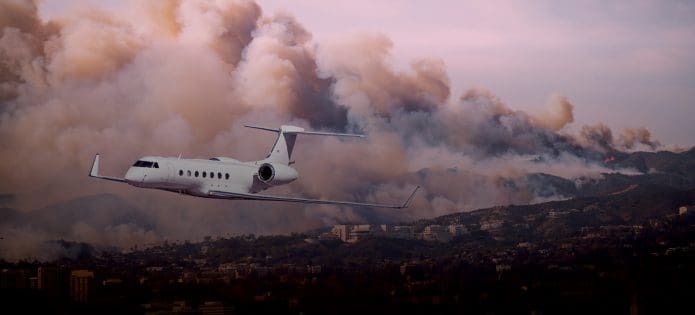
High Flyers 2026: The High Cost of Private Jet Excess


Introduction
Luxury private jets are the most energy intensive, ecologically destructive, and anti-social form of transportation. But thanks to a powerful private jet lobby — advocating on behalf of the wealthiest and most powerful people on the planet — the rest of us subsidize the high-flying lifestyle of this tiny slice of humanity, the wealthiest 0.003 percent.
This report, the latest in our High Flyers series covering private jet excess, highlights the costs of private jets to taxpayers, the public, and the planet, and recommends reforms.
Much more detail is available in the full PDF. A summary follows.
Key Findings
We all pay for the harms of private jet excess. U.S. taxpayers and commercial air travelers subsidize the luxury private jet transportation sector.
- Compared to the over 100 million Americans who fly commercial every year, only about 256,000 people fly on private jets — that’s just 0.003 percent of the population, including a slice of the ultrawealthy using fractional ownership or private charter jets.
- Yet this tiny number of private fliers account for a disproportionate share of flights — and fail to pay their fair share for their use of airspace and the costs of their carbon pollution. Instead, they shift the burden to everyone else.
- Private jets and charter services account for roughly 16 percent of FAA-handled flight operations, with the U.S. Department of Transportation estimating noncommercial private jets account for 7 percent of the airspace activity. Yet they contribute less than 0.6 percent of the taxes flowing into the Airport and Airway Trust Fund that helps finance FAA operations.
- The National Business Aviation Association spent approximately $2 million on lobbying efforts in 2025, focused on tax breaks for private jets and secrecy provisions. We are all paying for massive tax breaks that the private jet lobby works to insert into legislation that serves private jet owners, like the permanent accelerated depreciation tax of 2025.
As wealth inequality grows, so does private jet use. As the number of ultra-high net worth individuals and billionaires has grown, private jet ownership and use have also accelerated.
- The median wealth of a private jet owner is $190 million, while the median wealth of a fractional owner of a private jet is $140 million. Between 2019 and 2025, fractional jet ownership increased 65 percent.
- The U.S. is the primary driver of the luxury private jet expansion. It is home to 4 percent of the world’s population but nearly 69 percent of the world’s registered jets. Private jet operations and greenhouse gas emissions in two U.S. states alone, Florida and Texas, are greater than the 27 member countries of the European Union combined.
- Private jet operations and sales have surged since the pandemic — accompanied by increased demand for private jet infrastructure, including hangar space and airports that can accommodate private, luxury aviation. Like local contests over AI data center construction, communities are rising up to oppose private jet airport expansions because of local impacts and climate disruption.
- More than a third of all Airport Infrastructure Grants awarded through 2026 went to airport projects that may primarily benefit private jets, amounting to more than $1.13 billion in grant funds.
Private jets are super-polluters. On a warming planet, private jet operations are indefensible.
- A private jet passenger is often responsible for 10 to 14 times or more the emissions of a commercial airline passenger and roughly 50 times those of a passenger traveling the same route by rail — with the disparity exceeding 200 times on rail systems powered by low-carbon electricity.
- Private jets typically travel at higher altitudes than standard commercial airliners, contributing to aviation’s effective radiative forcing, which reflects climate effects that can be two to four times greater than those from CO2 emissions alone.
Contrary to the branding of “business” aviation, luxury private jets are mostly deployed for or combined with leisure, recreational, and luxury travel. Indeed, a growing number of wealthy children are traveling to summer camp in private jets.
- At least 50 percent of private jet operations are for recreational, vacation, and personal luxury travel.
- Events like Davos, the Super Bowl, and the Kentucky Derby are “carbon bombs” that attract ultrawealthy travelers who swarm to these global gatherings to see and be seen. These events include the Cannes Film Festival, U.S. Masters Golf Tournament, and Monaco Yacht Show. IPS’s new Private Jet Emission Tracker now has the capacity to measure emissions on specific flights and events, calibrated to jet size and fuel consumption.
- The 2026 FIFA World Cup alone saw more than 92,000 private jet flights, emitting 150 kilotons of excess emissions — the equivalent of 34,000 gas-guzzling cars driving for a year.
- Short hop flights make up a large percentage of luxury private jet travel. These flights could easily be substituted with alternative transportation options that generate significantly less pollution, like electric vehicle ground transport, high-speed rail, or other more efficient options.
The degradation of the commercial aviation experience (“enshittification”) is in part caused by the proliferation of luxury private jets.
- Private jets are worsening the air travel experience for commercial passengers, adding to airspace congestion, delays, pilot shortages that contribute to cancellations and rising costs, and stress on the air traffic system.
- In some airspace corridors, such as around New Jersey’s Teterboro Airport, private jets contribute to crowding and delays, especially during storm conditions.
- The system suffers from the wealthiest travelers “opting out” of the commercial aviation system rather than using their considerable clout to improve commercial aviation and public transportation for all.
The promotion of Sustainable Aviation Fuels (SAFs) as a viable solution for decarbonizing aviation is largely a green smokescreen.
- While there may be some potential for electrification of small scale short hop aviation, there is no scalable or cost-effective alternative to kerosene-based jet fuels developing at the speed of climate change.
- A vibrant and dynamic SAF market has yet to materialize. As a result, SAF production targets are continually missed.
- Price parity between SAFs and conventional jet fuel is unlikely due to the deoxygenation process required with renewable feedstocks, which adds a price premium.
- The necessary agricultural land use changes to produce SAFs could threaten global food security at a time when food prices are rising — as well as nature-based carbon sequestration solutions to climate change. Its widescale adoption may not reduce the life cycle of greenhouse emissions and may actively undermine our purported climate goals.
Solutions
Global ecosystems will be severely disrupted by the reckless consumption of this wealthy 0.003 percent of the population. Some solutions will require voluntary actions to give up private jets or limit their use. But real behavioral change will require increased taxes and regulations to change and decarbonize private jet users’ indefensible behavior.
- Stop another pending private jet tax break. Lawmakers must immediately strip the ALERT Act, legislation to improve air traffic safety standards, of provisions to prohibit jurisdictions from using ADB-S tracking to levy use fees and taxes. This cynical move, which attaches a private jet tax avoidance measure to legislation responding to the January 2025 collision over the Potomac, should be publicized as overreach by the private jet lobby.
- Repeal the one-year accelerated bonus depreciation of private jet purchases. Pass the End Subsidies for Private Jets Act, introduced by Rep. Eugene Vindman (D-VA), and other members of Congress.
- Increase taxes on private jet fuel. Lawmakers should levy taxes on private jets and eliminate tax subsidies so that jet users pay their fair share. One legislative proposal is to increase taxes on private jet fuel nine-fold to cover the real costs of private jet travel and invest in sustainable transportation.
- Pass a luxury tax on private jet sales. A luxury transfer tax on pre-owned and new jets could raise billions of dollars in revenue that could be used to build green infrastructure and decarbonize our economy. A luxury tax of 10 percent on used jets and 5 percent on new jets could have raised more than $3 billion in 2025, funds that could be invested in a sustainable transportation system for everyone, not just the billionaires and ultrawealthy.
- Rollback secrecy provisions around private jet travel and protect the public right to know who is burning up our future.
- Stop funding and constructing new private jet infrastructure, just as some institutions have committed to no new fossil fuel infrastructure.
Subscribe to our newsletter
Further reading
High Flyers 2026: The High Cost of Private Jet Excess

Gilded Giving 2026: Philanthropy Under Oligarchy