
Executive Excess 2026


Introduction
For the fourth year in a row, this 32nd annual Executive Excess report takes an in-depth look at the 100 S&P 500 corporations with the lowest median worker pay, a group we have dubbed the “Low-Wage 100.”
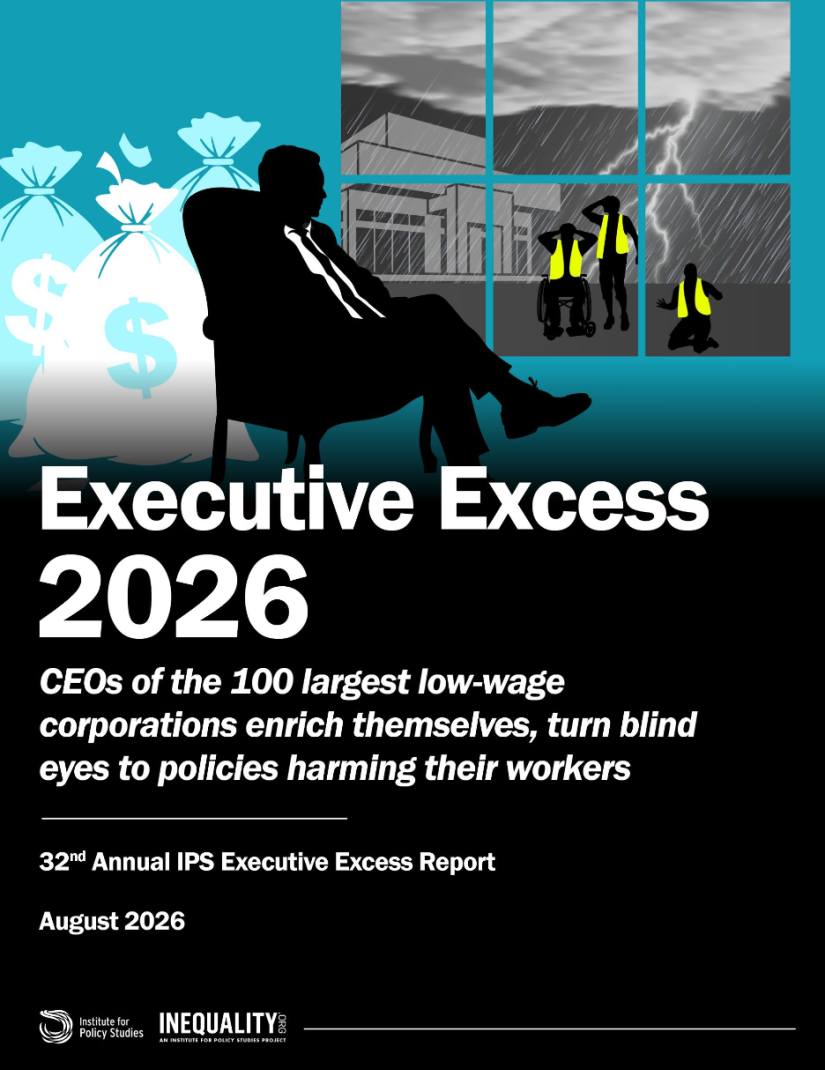
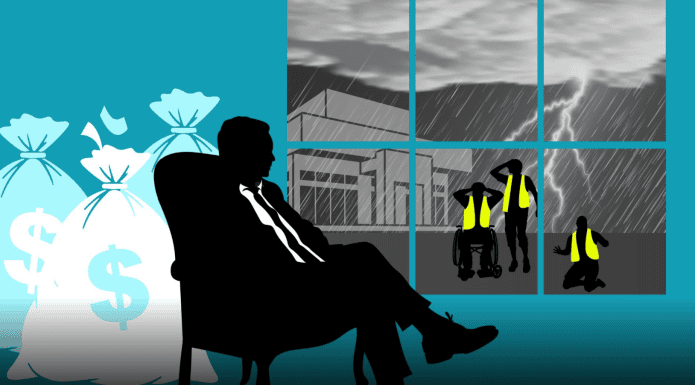
Over the past year, the CEOs of the Low Wage 100 pocketed huge paychecks while looking the other way as their employees grappled with fears of ICE actions, the loss of vital health care and food assistance programs, and attempts to roll back key protections against racial and gender discrimination.
When masked ICE agents grabbed their employees, CEOs declined to comment. When Congress made the largest cuts in history to Medicaid and SNAP food aid, top executives uttered not a word of concern about how this might affect the low-wage workers who rely on these programs. And when the administration attacked diversity, equity, and inclusion (DEI) programs, Low-Wage 100 leaders, with few exceptions, rolled them back.
None of these government actions are positive from a long-term business perspective. Our economy — and low-wage service industries in particular — relies heavily on immigrant labor. Workers are obviously more productive when they’re healthy and secure. And study after study has shown that workforce diversity drives innovation and boosts profits.
But pushing back on the government’s anti-worker actions doesn’t appear to have been a priority for the Low-Wage 100. Instead, they deployed most of their political power in 2025 to win more tax cuts for the rich through the One Big Beautiful Bill Act. Meanwhile, CEO pay at these firms continued to rise while their average median worker pay lagged behind inflation.
For each of these companies, we analyze CEO compensation, median worker pay, and stock buyback expenditures since 2019 — as well as how they’ve chosen to wield their considerable political power over the past year. We conclude with realizable policy solutions for pushing Corporate America in a more equitable direction.
Much more detail on these findings and our methodology can be found in the full PDF. A summary follows below.
Key Findings
1. CEO pay at Low-Wage 100 firms has soared since 2019 while median worker pay has lagged behind U.S. inflation.
- Between 2019 and 2025, average CEO compensation within this group rose 41.4 percent in nominal — unadjusted for inflation — terms, double the 20.7 percent increase in these firms’ average median worker pay. The U.S. inflation rate over this same period: 25.9 percent.
- Average CEO compensation within the Low-Wage 100 hit $17.5 million in 2025. The group’s average median worker pay sat at just $36,571 last year.
- The average CEO-worker pay ratio of Low-Wage 100 firms has widened from 574 to 1 in 2019 to 614 to 1 in 2025. Seventeen of the 100 corporations reported pay ratios of 1,000 to 1 or higher.
- The nominal value of median pay actually fell at 18 Low-Wage 100 corporations during this period.
- Lumentum, a company that manufactures AI data center technologies in China, recorded the widest pay gap in 2025. CEO Michael Hurlston made $27.7 million, 2,884 times as much as the company’s median pay of just $9,595.
- IBM CEO Arvind Krishna hauled in the largest compensation package in the Low-Wage 100, with $38.0 million – 765 times as much as the company’s $49,630 median pay.
2. From 2019 through 2025, the Low-Wage 100 spent $718 billion on stock buybacks.
- Over the past seven years, all but four Low-Wage 100 firms spent corporate dollars on stock buybacks. By repurchasing their own shares, companies artificially inflate executive stock-based pay and siphon resources out of worker wages and productive long-term investments.
- In 2025 alone, Low-Wage 100 firms spent a combined $108.6 billion on buybacks, up from $105.0 billion in 2024.
- Walmart ranked No. 1 in buyback spending among Low-Wage 100 firms in 2025. The giant retailer spent $8.1 billion on share repurchases — a sum that could have funded a $3,851 bonus for each of the firm’s 2.1 million employees. Doug McMillon, who stepped down as Walmart CEO on January 31, 2026, raked in $29.2 million in 2025 compensation – 958 times as much as Walmart median pay of $30,520. McMillon’s retirement benefits include deferred compensation valued at $169 million.
3. At least 36 billionaires owe their wealth to Low-Wage 100 companies.
- Six of these firms have spawned multiple billionaires alive today: Walmart (eight), Estee Lauder (four), DoorDash (three), Public Storage (two), Carvana (two), and Tyson Foods (two).
4. The Low-Wage 100 have wielded their political power to enrich CEOs while turning a blind eye to the harmful effects of government actions on their workers.
- Low-Wage 100 firms have a combined force of 1,282 registered federal lobbyists.
- In 2025, their lobbying prioritized the tax cuts for the wealthy and big corporations in the One Big Beautiful Bill Act, legislation that slashed Medicaid and SNAP programs on which many of these firms’ employees rely.
- Low-Wage 100 CEOs opted not to directly denounce aggressive ICE actions against their own employees, including the targeting of workers at big box retailers and delivery drivers.
- In the face of Trump administration threats, numerous high-profile Low-Wage 100 firms have rolled back DEI programs, including Amazon, Walmart, McDonald’s, Lowe’s, Tractor Supply, and Target.
5. Policy changes to address executive excess.
- Taxing extreme CEO-worker pay gaps: In one survey, 80 percent of likely voters expressed support for a tax hike on corporations that pay their CEO over 50 or more times what they pay their median employees.
- Increasing the buybacks tax: If Congress in 2022 had set our current excise tax on stock buybacks at 4 percent instead of 1 percent, the Low-Wage 100 would have owed approximately $9.3 billion in additional federal taxes on share repurchases in the three-year period 2023-2025.
- Leveraging government contracts and subsidies: A bipartisan provision in the pending Senate defense authorization bill would bar military contractors from engaging in stock buybacks. This builds on modest Biden administration progress to use the power of the public purse to rein in CEO pay. But governments at all levels could be doing much more to leverage this power against executive excess.
Company Profiles
Walmart
The CEO with the nation’s largest number of workers on Medicaid and SNAP took home 958 times more than the retailer’s median pay.
For the country’s largest private sector employer, this past year was marked by a number of superlatives. During his final year in the post, Walmart CEO Doug McMillon raked in $29.2 million — the largest compensation package of his career.
Among Low-Wage 100 firms, the giant retailer ranked No. 1 in buyback spending in 2025. Walmart spent $8.1 billion on share repurchases — a sum that could have funded a $3,851 bonus for each of the firm’s 2.1 million employees. Instead, those buybacks helped pump up the value of McMillon’s equity-based pay.
Walmart, a company that has generated eight living billionaires (more than any Low-Wage 100 firm), also had the dubious distinction of ranking first in a new GAO report on employers with the most workers enrolled in Medicaid and SNAP. This is hardly a surprise, since half of the retailer’s employees make less than $30,520. In the states GAO studied, Walmart had 16,055 workers enrolled in Medicaid and 15,515 on SNAP.
Walmart executives have opted to not use their enormous economic and political clout to speak out about safety net cuts and aggressive ICE tactics that have affected their frontline employees. In one January 2026 incident, video captured masked ICE agents dragging a Walmart associate, Somali high school student Suban Noor, from her car in Willmar, Minnesota. Noor, who is in this country legally, was released after five days in an undisclosed detention center.
DoorDash
A billionaire CEO remains mute as ICE targets his low-wage “Dashers.”
The DoorDash IPO in December 2020 turned three of its co-founders into billionaires. The co-founder who currently serves as CEO, Tony Xu, earned the relatively modest sum of $431,864 in 2025, just 12 times as much as the company’s $36,373 median pay. It is not unusual for founder CEOs to accept only a nominal annual salary since their real wealth rests in their stock holdings.
If we consider the highest-paid DoorDash executive, not the CEO, a more accurate pay picture emerges. In 2025, that executive — chief operating officer, Prabir Adarkar — raked in compensation worth $15.7 million, 432 times the DoorDash median pay. But even that ratio downplays the true extent of DoorDash pay disparities.
The company’s reported median pay figure does not take into account “Dashers,” the drivers who actually deliver the food and are central to the company’s business model but are classified as “independent contractors.” More than nine million people “dashed” in 2025. Those workers combined earned a total of over $20 billion that year, a figure that works out to just $2,222 per employee. Gridwise Analytics estimates DoorDash driver hourly average earnings, including tips, at $12.43.
DoorDash leaders have remained silent as ICE agents have targeted their drivers — at times with violent attacks. In July 2026, an ICE agent in Maine fatally shot a Dasher who was authorized to work in the United States and was not the subject of the agent’s arrest order. Another ICE agent is facing criminal charges after he chased a DoorDash driver in Minneapolis and then fired through the door of a home, injuring a family member of the driver.
Additional ICE actions against DoorDash drivers have been reported in many other cities, including Nashville, San Diego, and Portland, Oregon. After a surge of incidents involving delivery drivers in Washington, D.C. in 2025, a DoorDash spokesperson told a local reporter that they had neither informed drivers of their constitutional rights nor given any guidance about what to do if they are detained.
Home Depot
The big-box retailer focuses on pumping up CEO pay while ICE terrorizes workers outside their doors.
In 2025, CEO Edward Decker’s compensation hit $16.2 million, 427 times the Home Depot median pay of $37,881. The home improvement chain has pumped up the value of Decker’s stock-based pay through massive share repurchases. Since 2019, Home Depot has blown $37.9 billion on buybacks, enough to have given all 472,400 Home Depot employees a $11,449 bonus every one of the past seven years.
Similar to DoorDash’s relationship with their “Dashers,” Home Depot claims to have no legal liability related to the day laborers who are key to the company’s business model because they offer inexpensive and flexible labor for the contractors that patronize the chain. After White House deputy chief of staff Stephen Miller reportedly told ICE agents to target these vulnerable workers, the agency carried out a wave of Home Depot raids in Los Angeles, Chicago, New Orleans, and other cities.
A letter signed by 25 members of Congress points out that raids at Home Depot and Lowe’s stores have included the arrests of U.S. citizens, physical altercations, dangerous vehicle pursuits, medical emergencies, injuries, and the detention of individuals attempting to document enforcement activity.
One day laborer was struck and killed when he ran onto a busy highway after fleeing a Home Depot raid in Monrovia, California. Corporate officials declined media requests to comment on the man’s death. Home Depot’s official line regarding these actions on their own property: we “aren’t notified that immigration enforcement activities are going to happen, and we aren’t involved in them.”
Amazon
The world’s second-richest man remains silent as ICE targets his most vulnerable workers.
Amazon founder Jeff Bezos, like many corporate founders with enormous stock holdings, pocketed only nominal annual compensation during his years as CEO. As Amazon’s executive chair, he still collected just $1,681,840 in 2025, with all but $81,840 of that representing payment for his personal security expenses. Meanwhile, his staggering personal net worth has continued to explode. As of July 2026, the Forbes real-time tracker estimated Bezos’s wealth, nearly all of it in Amazon stock, at $254 billion, up by $33 billion over the past year.
In 2025, Amazon’s other named executives also received relatively small annual compensation packages because they had raked in multi-year mega-grants in recent years. CEO Andrew Jassy holds more than 2.3 million Amazon shares, currently worth $634 million. By contrast, median pay for Amazon workers stood at $40,206 last year, and the GAO ranked the company second after Walmart in the number of employees on Medicaid and SNAP. Amazon has used aggressive anti-union tactics to undercut workers’ efforts at several of their facilities to gain a fairer share of the company’s massive profits.
Like DoorDash, Amazon also classifies their gig workers, Amazon Flex drivers who deliver packages in their own vehicles, as “independent contractors.” The retail goliath has opted to not use their enormous political clout to defend these workers as they have faced aggressive ICE tactics in Seattle, Detroit, and elsewhere. One incident in Michigan prompted local elected officials to denounce ICE for detaining two Amazon Flex drivers from Venezuela who have protected status as asylum seekers. Amazon has also resisted calls to end their cloud service contracts with ICE.
Target
Once a diversity and inclusion advocate, the Target CEO ended his tenure as a wealthy man with a tainted record on social justice.
Target CEO Brian Cornell hauled in $21.8 million in 2025 — 794 times as much as the company’s median pay of $27,506. With wages that low, it’s no surprise that a GAO report of select states found that thousands of Target employees are having to rely on Medicaid and SNAP food assistance to get by.
But low wages weren’t the only challenge for Target employees over the past year. During the unprecedented surge of federal immigration forces in the company’s hometown of Minneapolis, agents appeared to place the big box retailer in their crosshairs. They intimidated employees and customers by staging their vehicles in Target parking lots, entering stores in groups wearing masks and carrying lethal weapons, and arresting employees.
On January 8, 2026, ICE agents wrestled two Latino employees — both U.S. citizens — to the ground at a suburban Minneapolis Target store and shoved them into an unmarked SUV. About two hours later, they dumped the men out in a parking lot in another town. Target officials declined to comment on these incidents of ICE targeting its employees. And when a pastor managed to get CEO Cornell on the phone during a faith leader sit-in at company headquarters on January 15, he hung up on her.
Target did later endorse an open letter with other Minnesota-based firms broadly calling for “deescalation of tensions and for state, local and federal officials to work together.” But Cornell’s handling of the ICE crisis further tarnished the reputation he had once sought to cultivate as a socially conscientious CEO.
In the aftermath of George Floyd’s murder by police in Minneapolis in 2020, Cornell became one of corporate America’s most forceful supporters of diversity and inclusion initiatives. The company pledged to increase its Black workforce by 20 percent over three years, spend more than $2 billion to support Black-owned businesses, and contribute $100 million to support Black-led nonprofits and provide scholarships to students attending historically Black colleges and universities.
Target quickly abandoned these DEI initiatives in the face of opposition from the second Trump administration, provoking a sustained boycott that company leaders acknowledge has contributed to declining sales. Cornell transitioned from Target CEO to Executive Chairman on February 1, 2026.
Dollar General
The discount retailer instructs its store managers to allow ICE to question employees.
Dollar General CEO Todd Vascos raked in $8.2 million in 2025 — 432 times as much as the company’s median pay. Half of the discount retailer’s employees make less than $18,876. GAO analysis of six states found that Dollar General had 5,601 employees enrolled in Medicaid in those states. In nine states, Dollar General had 5,197 employees receiving SNAP benefits.
Since the beginning of Trump’s second term, Dollar General employees have had to struggle with both poverty wages and pressure from management to cooperate with ICE. In January 2025, Dollar General’s top management sent a memo to store managers at their more than 20,000 stores on what to do if ICE agents enter a store and want to interrogate employees.
“Please allow the agent to speak with the employee,” the Dollar General memo instructed. “Ask the Agent to meet with the employee outside the store and away from customers and other employees if possible.”
Pressuring managers to subject employees to ICE interrogation undermines the constitutional right to refuse to speak with enforcement agents. In fact, the National Immigration Law Center advises employers to train their staff to not talk to agents to protect against self-incrimination. The Center also points out that if an ICE agent presents an administrative warrant with an employee’s name on it, managers are not required to take the agent to the named employee or even to say if that employee is working on that day.
Recommendations
We highlight here three particularly promising areas for reform. Appendix 2 in the full PDF catalogs a much more extensive menu of options.
Subjecting corporations with excessive levels of CEO pay to higher tax levies.
Higher tax rates on companies with wide CEO-worker pay gaps would create an incentive to both rein in executive pay and raise worker wages, all the while generating significant new capital for vital public investments. Laws that share those goals are already generating revenue in two major cities, San Francisco and Portland, Oregon. Members of the U.S. Congress have also introduced several related bills, including the Curtailing Executive Overcompensation (CEO) Act and the Tax Excessive CEO Pay Act.
A May 2024 survey suggests that such taxes would be enormously popular. Overall, 80 percent of likely voters favor a tax hike on corporations that pay their CEOs over 50 or more times more than what they pay their median employees.
Taxing and restricting stock buybacks.
A 1 percent federal excise tax on the repurchase of corporate stock went into effect in 2023. A Senate bill, the Stock Buyback Accountability Act, would quadruple this excise tax. If that 4 percent tax had been in place in 2023, 2024, and 2025, the Low-Wage 100 would have owed approximately $9.3 billion in additional federal taxes on their share repurchases, assuming no change in their buyback behavior. That increase would be enough to cover the cost of 352,598 public housing units each year for three years.
Another Senate bill, the ALIGN Act, would ban executives from selling their shares within a year of a stock buyback announcement. This would prevent CEOs from timing share repurchases to cash in personally on a short-term price pop they themselves have artificially created.
Using federal contracts and subsidies to discourage wide corporate pay gaps.
Under the Biden administration, the Department of Commerce gave preferential treatment in the awarding of $39 billion in CHIPS subsidies for domestic semiconductor production to firms that committed to refraining from all stock buybacks for five years. In response to pressure from Democratic Party lawmakers, Biden officials went even further to restrict buybacks for Intel, the program’s largest grantee, forbidding the use of any funds to repurchase company shares for the entire duration of the program, with limited exceptions.
Future administrations could do much more to leverage the power of the public purse against extreme pay disparities. The Patriotic Corporations Act could serve as a model. This bill would grant preferential treatment in federal contracting to firms with CEO-worker pay ratios of 100 to 1 or less, among other benchmarks. The Congressional Progressive Caucus has supported such incentives.
Share It On Social
Bluesky:
NEW: At 100 major U.S. companies last year — including Target, Walmart, and DoorDash — the average CEO took home $17.5 million while turning a blind eye to workers losing Medicaid and SNAP or being attacked by ICE. Protect workers. Curb this out-of-control CEO greed. REPORT:
— Institute for Policy Studies (@ips-dc.org) August 27, 2026 at 9:31 AM
[image or embed]
Instagram:
TikTok:
@ips_dc NEW: This year, workers have suffered — and their CEOs have ignored it while raking in millions. Visit ips-dc.org to see our new findings, out today, and popular policy solutions that would curb this greed. #fyp #news #jobs #economy #taxtherich ♬ original sound – Institute for Policy Studies
Subscribe to our newsletter
Further reading
Executive Excess 2026

A Perfect Storm: How Federal Policy Changes Are Increasing Economic Insecurity for America's Families