Barriers to Implementing Sustainable Aviation Fuel (SAF) in Massachusetts
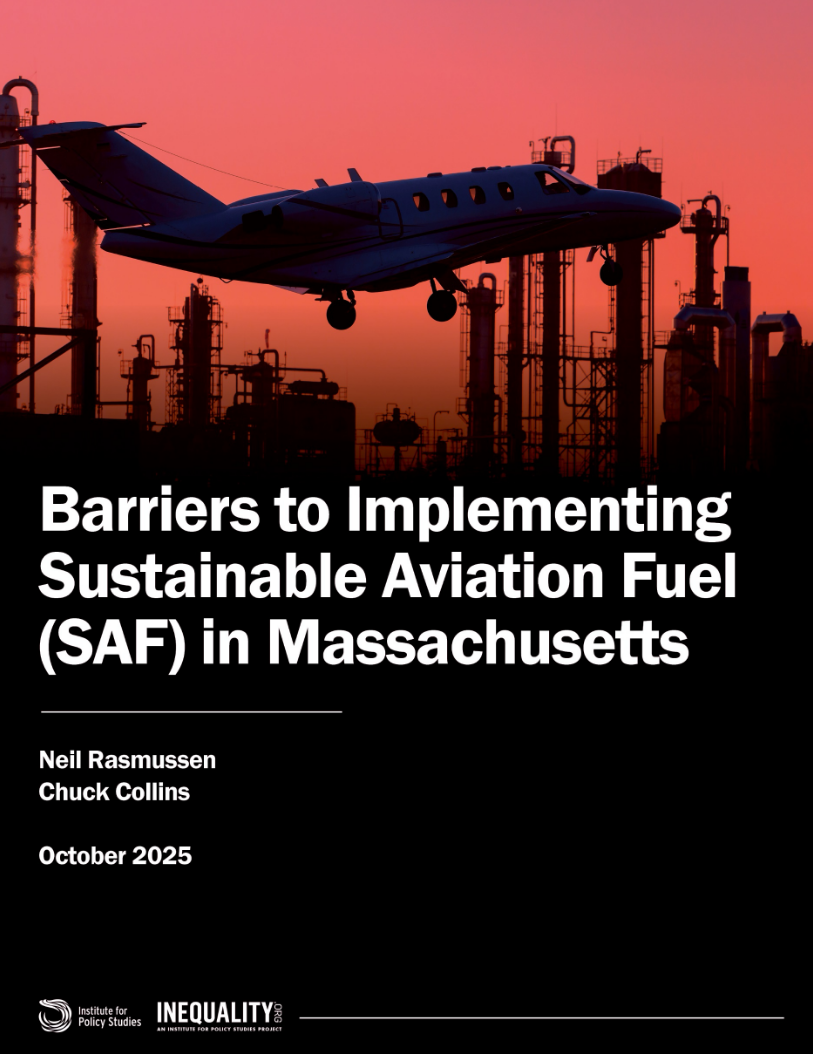


Click here for full IPS report
Introduction
Massachusetts is one of the few states considering policies to subsidize Sustainable Aviation Fuels, or SAFs. This IPS report reviews the flawed policy recommendations from a recent report by an ad-hoc SAF working group convened by Massport, a state agency.
The report of the Massport’s ad-hoc Sustainable Aviation Fuels (SAF) Working Group claims that SAFs “have the potential to dramatically reduce lifecycle aviation emissions to near zero by 2050.” It offers recommendations about SAF, including further research on its emission reduction potential, the prospects for the local industry, and the use of subsidies to encourage early adoption.
This IPS paper reviews the best available science to determine the feasibility, energy requirements, affordability, and timetable regarding SAF. It finds that, unfortunately, aviation growth cannot be reconciled with the Massachusetts plan that requires emission reductions, unless low-emission fuels are available now. Yet all recent discussions regarding SAF are hypothetical and notably devoid of any commitment or timetable regarding the implementation of SAF.
The findings of the IPS report indicate that hypothetical future use of SAF should not serve as a green light for expanding aviation. We find that SAF solutions provide minimal or negative greenhouse gas reductions. They will not be available on a timetable that will contribute to the 2050 Massachusetts emissions plan. And in any scenario, they would require massive public subsidies.
These critical drawbacks are explained at length in the full IPS report. A summary follows.
Key Findings
Sustainable Aviation Fuels won’t help Massachusetts reduce greenhouse gas (GHG) emissions.
- As the Commonwealth reduces GHG emissions in many sectors, aviation emissions continue to rise. The CO2 emissions from jet fuel consumed in the Commonwealth today are 5.9 megatons per year and growing, while the City of Boston’s emissions today (all sources except aviation) are 6.0 megatons per year and falling. The technical options to address aviation emissions by 2050 are limited.
- Supporting basic research aimed at improving the efficiency of SAF production is prudent. However, proposals to drive production or consumption of SAF through economic policy or subsidies do not make financial sense, as SAF currently — and for the foreseeable future — increases GHG emissions.
- While subsidies can be enacted at the state level, the subsidy required to drive the wholesale conversion to SAF would be unfundable.
- SAF solutions will not be available at scale on a timetable that will have any significant benefit to the 2050 Massachusetts GHG plan.
E-fuel technologies are not realistic for Massachusetts.
- The huge diversion of clean energy to e-fuel production will increase GHG emissions and be prohibitively expensive.
- CO2 emissions are five times lower if we direct new clean electricity to the grid to displace natural gas, instead of using it to create e-fuel SAF. Put another way, a switch by Massachusetts to e-fuel based on grid electricity would save 5.9 MT of fossil jet emissions but add 21 MT of grid emissions, for a net increase of 15.1MT of CO2 per year.
- To displace current fossil jet fuel use with e-fuel in Massachusetts would require annual subsidies of $2.9 billion to $16.5 billion. This is 2 to 12 times the entire annual Massachusetts Transportation budget of $1.37 billion.
- The magnitude of electrical power required to produce e-fuel to meet Massachusetts aviation requirements is much more than the Commonwealth generates today.
- Until the utility grid is completely decarbonized, every kWh of clean electricity generated must be applied toward the maximum reduction in CO2, and not toward the inefficient production of e-fuel.
In general, SAF simply isn’t a feasible way to reduce emissions at scale.
- The most severe and unsolved problem with SAF is that its use increases CO2 emissions.
- Any of the SAF production scenarios would require massive taxpayer subsidies.
- Land use for crop-based fuels would compromise food security and lead to deforestation with attending reductions in CO2 sequestration. Inexplicably, the SAF Working Group’s recommendations fail to exclude proposed subsidies for this pathway.
- Technical options to reduce aviation emissions by 2050 are limited: electric aircraft will only address a fraction of short-haul flights.
Conclusion and Recommendations
The two best ways to decrease CO2 emissions from aviation today are:
- Ensure that inefficient modes of aviation are avoided. The Commonwealth should implement policies and infrastructure to transition short-hop local flights using small aircraft, like Cape Air, to electric aircraft as soon as possible. The Commonwealth should also reduce the use of private luxury jets, which produce the highest CO2 emissions per passenger mile. Subsidies for these aircraft should be eliminated.
- Replace short flights with high-speed rail or other electric ground transportation. A significant portion of Massachusetts’s jet fuel is used for flights to the Northeast Corridor. The Commonwealth, working with other corridor states, should prioritize the development of true high-speed rail through legislation, eminent domain, and other methods. This presents the Commonwealth’s greatest opportunity to cut aviation-related GHG emissions by 2050.
Aviation emissions can only be reduced this century by flying less — particularly eliminating wasteful or inefficient trips — and by investing in low-emission ground transportation. Relying on speculative, expensive SAF far in the distant future is a dangerous excuse to avoid confronting jet aviation’s greenhouse gas problem now.
Background:
- Massport pushing to make the state a hub for sustainable aviation fuels, Boston Globe, 6/5/25
- MA Sustainable Aviation Fuels (SAF) Workgroup report: Recommendations to the Governor on Accelerating the Adoption of Sustainable Aviation Fuels in Massachusetts
Subscribe to our newsletter
Further reading
High Flyers 2026: The High Cost of Private Jet Excess

SYMPOSIUM ROUNDUP: Forging a Democracy That Works for All