VIDEO: Organizing to Defeat Fascism and Deepen Democracy


Below is a lightly edited transcript of a panel at our third annual Wallace Symposium, called “Forging a Democracy That Works for All.” Watch and read more from the symposium here.
John Cavanagh: I’m John Cavanagh from the Institute for Policy Studies, and I welcome you to panel one of three. This one is on organizing to build power, defeat fascism, and deepen democracy.
As you’ve all heard, Henry Wallace had something to say and had wisdom for any possible moment. So on democracy, here’s a sentence from him from his acceptance speech at that convention where he was the Progressive Party candidate for president in 1948. He said, “I am committed to using the power of our democracy to control rigorously and, wherever necessary, to remove from private to public hands, the power of huge corporate monopolies and international big business.” Bold.
So seated beside me here are three of the most inspiring organizers and strategists in the country today. They are also three of the nicest people that I know, which makes this a special privilege this afternoon. So, a couple of sentences on each of them right here.
Kate Hess Pace is the executive director of Hoosier Action, the largest organizing group in the state of Indiana, and she is the Henry A. Wallace Rural Organizing Fellow at IPS. Prior to Hoosier Action, Kate spent close to a decade with Isaiah, Minnesota’s largest faith-based and community organization. There’s a Minnesota throughline you’re going to hear today. There’s something about Minnesota. Sarah Anderson grew up in Minnesota. Something in the water there that’s very powerful.
Next, Erica Smiley is the executive director of the dynamic labor-community-student-faith combining organization Jobs With Justice, where I’m proud to serve as a as a board member, and where she has been an innovator in taking on powerhouses like Amazon and developing a brilliant strategy for organizing workers in the South, including in Jobs With Justice’s creation, the Advancing Black Strategists Initiative.
Finally, Khury Petersen-Smith is co-director with Phyllis Bennis of IPS’s New Internationalism Project, and is a leading public scholar on militarism and peace. Just to give one example, he was a lead co-author and organizer of Black Voices for Ceasefire, which was signed by over 6,000 Black activists, artists, and scholars. So, if you came for inspiring organizers and strategists, you’re in the right place here today.
Okay, so in the midst of this five- alarm fire of democracy and militarism today, our overall aim in this next hour is to lift up innovative organizing work taking place across different contexts and issues, and to explore their differences and their intersections. And in the process, we want to consider both how communities and movements are blocking bad policies and how they are building power to transform these conditions and nurture true democracy.
So we’re going to have two rounds. I’m going to ask two rounds of questions to these three, and then we’re going to open it up to all of you. And we will have Wallace Fellows kick things off with the first question, but then we’ll have them running microphones through the audience for all of you to ask more. So think of things as you listen.
Okay, so I’m going to start with Kate right here. Your work with Hoosier Action in rural America, begins with the premise that our democracy must be rebuilt at the local level, starting with building relationships among neighbors. Can you tell us what have been your efforts to build people power in Indiana? What have they taught you about the fallacies of reinforcing partisan divides, and where do you see potential openings for a political realignment? And again, welcome.
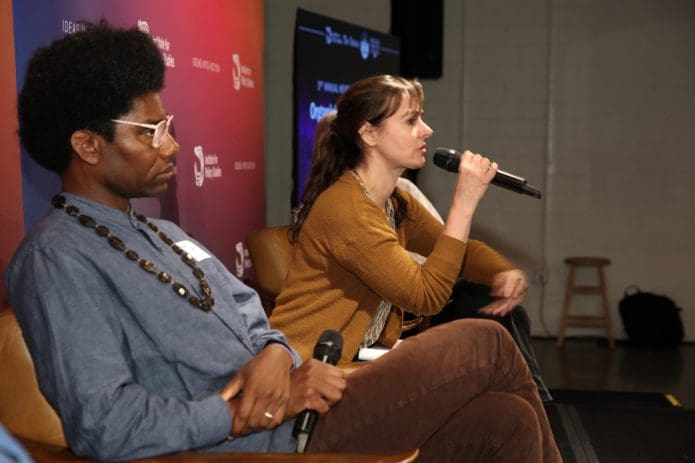
Kate Hess Pace: Thank you. It’s very great to be here. I’ll give some quick background. So I started Hoosier Action nine and a half years ago. I’d been organizing Minnesota for the previous decade, like John said. But I’m from Indiana. My family’s lived in Southern Indiana for 150 years, and felt a pull and a call to bring the thing I loved, which was really good organizing, to the place that my family and community lived.
So moving back, I learned a set of hard lessons, including that you couldn’t take an urban organizing model and import it to small town and rural Indiana, and that the organizing as as beautiful and disciplined and as rigorous that we had done in Minnesota was resting upon a functional society and the conditions for democracy, which we did not have in rural and small town Indiana.
The organizing model I was taught was like go to the neighborhood, round up the people, go down to the city, ask for the resources, and local media will cover it. None of that exists. There aren’t institutions that bring people together. There isn’t a fabric of practicing democracy or feeling like your desires and what you want can be manifested in the world. There’s no local press to cover it, and really the only politics that existed was the nationalized partisan politics. That’s really not about us or where we live.
So that made us back up and ask, what is it going to take to actually bring people together and win the things that we need at the local level? And we realized, nobody is making meaning over the fact that you can’t drink the water in your town or the fact that there are only dollar stores. And we realized that is the space where we can really grow people’s worldviews towards a more humanitarian space, while actually winning real things for them.
So we created a model that we call a three-pillar model. We’re a secular organization—though most of our members are religious—and so the first pillar is church. How do we have spaces and places you can walk in and belong to? One where we know your name, where we’re going to have a shared values system together, where we don’t care who you voted for. We care about you, and your family, and what you want in the world. And we want to show and have that experience for more and more people—that it is in community and with collective action that we can get more and more done.
The second pillar we call bomb shelter. I was raised in an organizing world that created a distinct line between charity and organizing, and we wanted to go upstream, not just to feed the people today, but ask why are they hungry? And we were going to work on addressing why they are hungry and work to raise wages, etc. But we realized that the poor and working class population in rural Indiana needed a floor. That means that not only do we have meals and childcare at every meeting, no matter what, but we also have food donation drives, ways that we can connect people to resources, and know-your-rights trainings for renters. And we understand that if you’re going to participate in democracy, you need to be fed today.
And then the third is what we call vanguard, which is just a true commitment to figuring out how we train and orient people to people power. And I always want to tell people: you can only eat what’s at the buffet. And if there are no organizations shaping people or helping them to think about and question why things are the way they are, then people will stay stuck and be easily manipulated by outside forces. So really committing to training and popular education that brings people in and makes meaning with them. Okay, I’ll stop. I’ll say more later.
John Cavanagh: Okay, thanks so much. All right, now turning to our dear friend Erica Smiley. Smiley, you and Jobs with Justice have taken on Amazon, the world’s largest corporation in terms of sales. They never think small at Jobs With Justice. Can you say a little bit about what you’ve won in this campaign and how you see it contributing to the fight against authoritarianism and the fight to save and expand democracy.
Erica Smiley: Well, I appreciate the introduction. Also, you’re the first person to ever call me nice, which I really like. I mean, I’m going to lean into that. Very kind.
John Cavanagh: Don’t believe the toughness you’re about to hear.
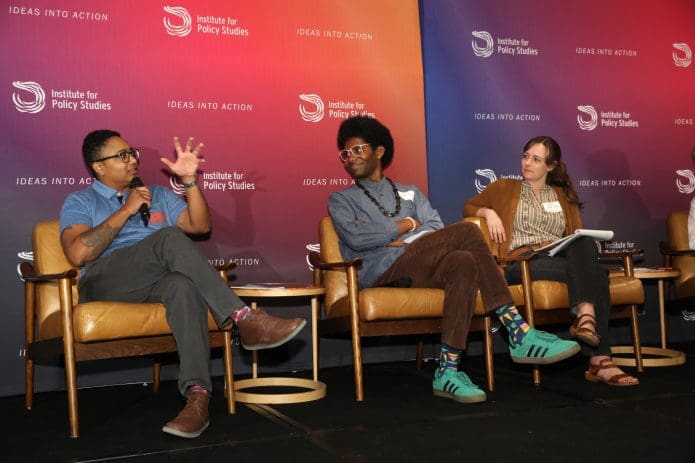
Erica Smiley: And I also want to appreciate the opening remarks and starting with Hoosier Action. I am co-parenting with someone who did a very similar thing, which was to go back to their home state in southeastern New Jersey and make meaning for a population that would otherwise be very, very conservative. and so they’ve learned all the similar lessons. So I just want to appreciate that, even though we like to think big, the work itself is still very similar to what you described in Indiana, that there has to be childcare at every meeting of Amazon workers. There has to be food provided and basic things like rides.
Here’s what we have been trying to do. I will take it up, and then I want to come back down to that. Amazon is a company that treats itself like a nation state, in how it governs itself and how it organizes. We have the 50 states of the United States; Amazon has the eight regions of America and different across the globe. So what we learned was that we can pass all these great laws and policies: we got the Warehouse Worker Protection Act and the Warehouse Worker Injury Reduction Act in New York, and federally we got the Pregnant Worker Fairness Act. Amazon doesn’t feel like they have to implement those laws because that’s not the same system through which they govern.
So we realized that what we had to do was design a campaign that would not only win policy and create pressure on companies like Amazon, but one that would fight internally to ensure that we have democratic decisionmaking over the policies that the company enforced and operated under. And that’s essentially what we do at Jobs with Justice. That’s our whole premise: the fight for democracy isn’t just at the ballot box; it’s on the shop floor. In fact, the fight for democracy is raging on the shop floor, and workers at Amazon will tell you that.
One of the biggest examples of that recently is in the fight for pregnancy accommodation, which I mentioned. So despite having these laws, the company hasn’t been obeying or providing appropriate and adequate pregnancy accommodation for an overwhelming number of its workers—even though if you look at the gender breakdown and demographics of Amazon, the average Amazon warehouse worker is almost equally split half and half and they’re all of childbearing age. Or 92%. Sorry, I shouldn’t say all, I know we have scientists in the room.
So what we have is a crisis where people want to have good jobs and access to career paths in warehousing, because in some places, Amazon is really the best job. And yet as soon as they get pregnant, they’re almost punished for that, or their partners are punished for that. And they have lost not only time and wages, but they’ve lost their homes, and some of them have lost their pregnancies.
And when they speak out about it—we’ve spoken to legislators who are up in arms and regulators who want to do something about it—and the company just says “it’s the cost of business, the cost of business.” And then we talk to the company’s investors, and then the worker gets fired. In fact, Tamesha Banks is one of the most recent casualties of this success. (And there is GoFundMe for Tamesha, I will share the link afterwards.)
But we do know that this is a vulnerability for the company, because they are trying to expand into other sectors, including healthcare and the like. I can sit here and take up the rest of the session specifically on Amazon. I won’t. I’m going to avoid the will to do that and try to get back to what I think are probably more interesting talking points for this space, which is to say that as much as I appreciate a lot of our discussions about voting and our discussions about policy and legislation, I think—in the spirit of Henry Wallace—that we should be focused a little less on policy and a lot more on power.
And there was a prep question. I don’t remember if it was for this event or something else. They were like “what are your top three issues?” And I was like, “Democracy, democracy, and democracy. And did I mention democracy?” Because what we really want is the ability to govern—wherever we are, whether that’s in a local church, whether that’s in my warehouse, making sure that we get a say in what the temperature is in this facility, or whether I’m setting industrial standards for logistics and distribution.
But it’s the ability of everyday working people to have a say—especially in a company that treats itself like a nation-state and a company that is starting wars in many ways. And what they’re doing and what they need to pull out of the ground, the amount of energy we need to run the data centers that Jeff Bezos wants, it doesn’t actually exist on Earth.
You know, like these are the types of companies we’re dealing with. They were never predicted by Robert Wagner when he was writing the National Labor Relations Act. They weren’t predicted by Thomas Jefferson and the other white guys who wrote the Declaration. They weren’t predicted, right, and so we have to operate sometimes outside of that framework to try to imagine what democracy looks like in this new climate, in this new global economy.
We have to imagine what it means to have everyday people have access to governing, and for us at Jobs for Justice, we center that on collective bargaining. It’s one of the best pathways to increase governance in an economic and a workplace setting. Now, does it have to be the traditional bargaining that we’ve seen over the last 20th century? Absolutely not.
And in fact, and again, this gets back to Indiana. I’m so glad we started with Hoosier Action. What we’ve learned is that in this country, people who have had access to 20th century means of democracy, 20th century elections…where, you know, you’ve got the machine, you go to the neighborhood, you flush everybody out, you get enough cards, you’ve got a union. Great, they can access governance and power that way. They should. Doing that in Minnesota, in New York, in Chicago, in San Francisco, like for Christ’s sake, please keep doing that.
But what we learned in the other places was that we had to really distinguish between people who have long lost access to 20th century democracy, people who recently lost it, and people who never had it—because how we organize there has to be different, right? And I can’t go into Indiana necessarily talking about the Fight for 15 because there’s still people who are like, “I remember when the factory paid me 25, and that was 1975.” You know, they’re very clear.
Whereas if I go to my home state of North Carolina, what I’ve learned is that people who long lost, if they ever had access to, 20th century forms of democracy actually are not just backwards stuck in time. The appetite for something better and something different that actually applies to them is far greater than what we see in other places. The appetite for a democracy that was promised through Reconstruction, not the New Deal, is what a lot of people are hungry for. A democracy that they can see themselves in.
And so when we think about that, and when we try to build models, including just everyday models on the church floor, in the Amazon warehouse, in the community center, or at the ballot box, which is also incredibly important, we have to also see the battlefield of our workplaces, the places where the majority of us spend the bulk of our time, as places and centers of gravity in the fight for democracy.
And so, in choosing Amazon, and we’ve chosen other industries as well—John’s being very patient. This is me not being nice. He’s giving me this look, it’s a very kind look, but it says shut up. But in choosing Amazon and other industries like manufacturing, it’s not just thinking big, but it’s trying to understand what are the economic drivers, what are the economic containers that are either holding their own governance and preventing ours, and that are undermining our system of democracy. We can’t just have a political democracy without an economic one. And so we have to go to the jugular, both to save our democracy, but also to build the one that we always aspired for—the democracy of our ancestors’ dreams.
John Cavanagh: Beautiful. By the way, Smiley has written a book with Sarita Gupta, our IPS board chair, on precisely this topic and that I recommend to all of you. Okay, turning to Khury. And you’re sitting there maybe thinking, rural organizer, worker organizer, peace organizer… what do they have in common? That’s basically the philosophy of IPS. So you’re about to find out. So Khury, we’ve seen a groundswell in this country demanding that the U.S. end its pursuit of forever wars, along with its ongoing support for Israel’s genocide in Gaza. How has the deeply unpopular war in Iran created further opportunities to expand this coalition? And what do you think the peace movement’s goals should be over the next couple of years? Small question.
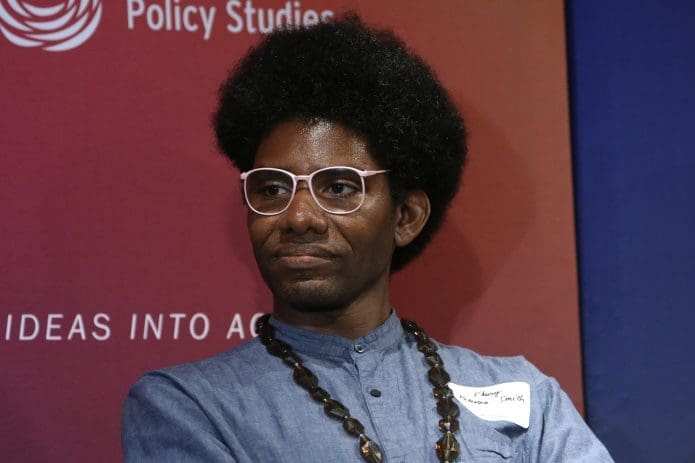
Khury Petersen-Smith: Yeah, I love this question. What an awesome panel! I also want to, like Tope and others, begin by recognizing and honoring the legacy of Henry Wallace, and in particular his internationalism, which is not only a testament to his life’s work, but a reminder that the progressive movement has included visions and programs that go beyond the borders of this country, and that more recently we’ve really lost that.
Actually, for too long, the progressive movement, I think, has not thought enough about what a progressive agenda is that is international. And for too long, I think we’ve accepted the notion that we can have a progressive vision that stays within the borders of this country. And that is changing, and it’s extremely important. And this is the context in which you raised the question, John.
It’s difficult because, on the one hand, what is driving a set of what I will call opportunities—but what I really think of as responsibilities—is a run amok Pentagon. Just in the past year, in addition to this catastrophic war in Iran, we have bombings of Yemen, we have bombings of Nigeria, the U.S. joined Israel in bombing Iran last year. We have these horrendous airstrikes on these boats in the Caribbean. We have an attack on Venezuela and the abduction of the head of state.
So this person who campaigned against wars and militarism—which we should understand as a testament to actually the population of this country, one in which those things are unpopular—there was a credibility that he got by campaigning against those things. And yet he has massively expanded and escalated militarism and war, and this comes in the context of the Gaza genocide, which has been catastrophic beyond words, and which continues to be because it is ongoing, and which has also galvanized people in this country in ways that are frankly historic.
The attention to the realities and the rights of Palestinians that we are witnessing at the moment really are unprecedented. Regarding Palestinian rights, nothing like this has ever ever happened before in U.S. history. And it has revealed something actually about people in this country. As somebody who has worked on questions of war and peace, militarism, I’ve been told throughout my life that “Americans will never care, actually.” And we are seeing–and again, I want to be careful with how I celebrate this because it has come at an unimaginable price for Palestinians—but what we have seen is that when Palestinians get to speak directly to Americans—on their phones, on our phones, because we can see it—-not only do people care, but people are willing to do quite a lot, and are willing to take risks, out of a commitment to what has become really the moral question of our time.
So, in that context, Trump joins Israel and launches this war against Iran, which, by the way, has a twin Israeli war in Lebanon, combined with the ongoing genocide in Gaza. And it is producing, again, enormous suffering in those places. And also, our movements are engaging with this reality in a way that’s opening up possibilities that I don’t know if we’ve ever seen, actually.
Just today again, there was another War Powers Resolution passed. I’ve been telling my colleagues at IPS about this, how one of the things that I don’t look forward to every year is the introduction of the military budget, the National Defense Authorization Act, because we always know what’s going to happen. They’re going to propose something horrendous. We will fight the good fight to strip out the very worst things, and then we know that it’s going to pass. It’s kind of a familiar pattern that is a fight worth fighting, but we generally know how the story goes. This year, I don’t know how the story goes, and that’s a good thing. So we need to put our heads together and think about what is possible at the federal level. We need to remember that policy is not only federal, but it is local too, and explore what is possible at the local level in terms of manifesting and mobilizing this anti-war opposition. And we need to take it as far as it goes.
John Cavanagh: Beautiful. Thanks. Okay. So I’m going to do one more round, and I hope you’re thinking of questions you would like to ask here. You’ve each spoken of different movements. How can our movements put forward a bold vision for the future that can not only defeat fascism but renew the promise of democracy? Now let’s go in the same order. Kate, you go ahead.
Kate Hess Pace: Okay. I was going to say a couple things in different directions. So I think it’s really important to just remember and hold onto the fact that people will not and cannot defend what they don’t experience, what they haven’t experienced, what they don’t know. So the abstract fight for democracy has to move from an abstraction to places and spaces where people can actually participate, doing things and achieving things together for a purpose.
And I want to name, to your point, that it’s not going to be a policy that gets us out of this or one election. It really will be more and more people throwing their lots in together and figuring out how we’re going to govern each other. And so, where I live, we don’t make anything anymore, we don’t grow anything, we don’t produce any culture. So reestablishing that our lives matter, where we live matters, our community matters is key.
We’re doing a big future festival in the spring where we’re just inviting everybody in small towns and the rural area around us to imagine: what do we need the future to be? Because I realized that nobody gets asked that where we live. What do you want it to be? What do you want technology to do for us? How do you want us to be connected? and how do you want to change the spaces and places around us?
So I’m calling for a more human orientation that understands that politics is not democracy, that your opinion is not the totality of your humanity, and nobody’s opinions are, and for us to build something big enough for a wide amount of people to imagine themselves in and impact and affect.
So inside of Hoosier Action, that looks like relatively small projects that hopefully can get replicated. We have a set of members that just trains people to go to city and county council meetings, to record them, and then to publish what decisions are being made on your behalf. We have a transparency and accountability in government group, because without local media, there’s an unbelievable level of corruption in local and county governments. And training our people to go watch it, find it, and fight it, like with the misuse of the opioid settlement fund, builds leadership, builds capacity, and also connects people to the thing that has been so abstract in their life, which was that we elect these people to represent and serve us. They’re yours.
So we need spaces and places where people get trained to engage and make the connections to the things they want and need. But also I always want to reiterate: the Trump vote is not a joyful vote. That is not a vote of people doing great. That is a vote of people searching for something to give them change, and to stand up for them. And so we could have the election results that this room wants in the midterms—and if we don’t get more solidity underneath it, we’re actually going to be on a path towards worse fascism. So how do we keep connecting to people and not allow ourselves to just reiterate the partisan divide? And instead, I hold and see your humanity no matter what, and that’s the team I’m on.
John Cavanagh: Thank you. Now, Smiley, the twist for you on this is that you and Jobs With Justice have pioneered a very bold Towards a 21st Century Reconstruction Agenda that attempts to build on the wins of the New Deal, also the Great Society, while addressing their shortcomings. So, could you say a little bit about that?
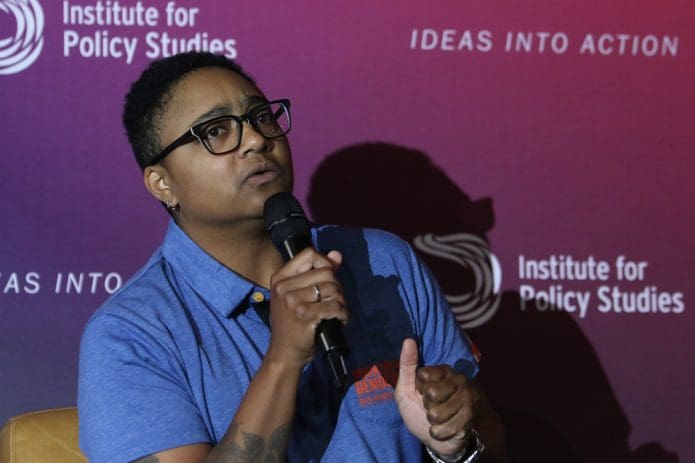
Erica Smiley: Yeah, a little bit. And he then set me up right after Kate’s, like, you know, “Let’s bring it down. It’s got to be simple. Let’s talk about the big abstract idea—goddamn it, John!”
First of all, there’s a reason why unions have been called schools for democracy, because they’re the place where people can consult, confer, discuss some of the tough issues—and yet do that in a context where they have to orient around a common enemy, with some common cause. And that’s part of building the labor movement. We want to keep that, we want to expand that—even if the agreement doesn’t look the same, or the industry has changed. Like, that bread-and-butter stuff is key.
And that was part of what was in the book that Sarita and I wrote—it’s part of what’s behind the blueprint for democracy that Jobs With Justice put together. And actually, our policy director here, Adam, and Aaron, our research director—who really did the bulk of the work to, like, synthesize—you know, I’m not short-winded at all, I don’t know if you’ve noticed—but to synthesize that into two pages.
And there’s—it’s a very simple core, which is to say: when I talk about the top three issues, and I say “democracy, democracy, democracy,” whatever policy, whatever issue, whatever container through which you are fighting for democracy—if you incorporate governance as a part of it, then you are expanding democracy. If you incorporate some kind of enforceability that those who are directly impacted have a participating role in—if those who are directly impacted get to shape it—that is democracy. That’s the blueprint. It’s actually not that complicated.
I mean, we put a bunch of issues on there because people expect us to—you know, what are the worker issues, just cause—we know how to punch around, do the dance. But at the end of the day, that’s all it is. You could be fighting around climate issues. You know, we say we want to build a labor movement that can stop war—so what’s the enforceable mechanism there? Like, how are we inserting that on the front end?
But here’s what I’ll say, and this is why I also really appreciate some of Kate’s reflections, I’m being a little self-reflective on this: when it works, democracy is so boring. I mean, like, really dull. Like, I had this opportunity to sit with some film people at USC, in Southern California, where they do that stuff, and they’re like, “Smiley, we really want to figure out how we’re inserting more labor stuff into these scripts.” And I was like, awesome.
And they’re like, “All right, so tell us—tell us about Scabby the Rat, tell us about the protests—what is it like in the daily life of a union shop?” And I was like, “Well… the daily life of a union shop, when it works, is actually pretty simple.” You could just show, like, maybe someone’s like, “Oh my goodness, we’re pregnant,” and everyone celebrates, and then they send her to the steward to get the form, and then she takes leave, and then, you know, everyone covers, and then she comes back and she still has her job—and maybe even she gets a promotion.
And they’re like, “What?” And I was like, “Well, that’s when it works. That’s what we’re doing here.” You know, they made the decision, they passed the policy, they implement the policy. It’s all very simple.
And so it is important—and this is something that Sarita was always really good at pushing me on, and it’s something we tried to put forward in the blueprint—which is to say that the “so what” can’t be left out of our efforts, right? We fight for democracy… so what?
So that people can go to that baseball game this weekend. So that people can learn to play the violin later in life. So that people can have joy. So that people can live—and experience life. And as she used to say, work to live, as opposed to live to work. That’s what we are ultimately fighting for, and that’s also ultimately how we will build a powerful movement to fight for democracy.
And I’ll end my remarks in this moment on this—especially in response to this question of wars and constant militarization. I was privileged earlier this year to be at the swearing-in of the first Black woman, the first of a lot of things, president of the United Steelworkers, Roxanne Brown. It was amazing, in Pittsburgh. For any of you who missed it, it was amazing. It was a thousand people in this crazy auditorium, and at some point the president of the Mine Workers, who some of you know, Cecil, stood up. And you never really know what Cecil’s going to say, but you know he’s caught the spirit. He kind of gets this shape to him—it’s like a mixture of John Brown and Billy Graham—and he just starts talking.
He says, “People in Congress are going to start sending our children off to war, and we aren’t—we aren’t with it.” And now I want to say something about this room. This room of a thousand people—maybe 30% of us were from throughout the labor movement, diverse populations, other union presidents, officers—but the rest were steelworkers. The rest were steelworkers. And, you know, they were diverse, but it was still a lot of guys, a lot of white guys, a lot of Midwest energy happening in there.And when Cecil said this, I said, “What are they going to say?” And when I tell you—the auditorium exploded in cheers.
Because I agree. I think that we have to talk to all of our people. We can’t fight white supremacy without talking to white people. We can’t fight patriarchy without figuring out the strategy for men. There has to be a theory where we are building a vision for democracy together—where we can all see ourselves in it.
And that’s where I want to come back to this notion of unions and worker organizations, historically, as schools for democracy. Because that is one place where everybody’s there because they got the job. Now you’ve got to figure out how you’re going to govern together.
And that’s our challenge today. It’s not simply: how are we going to pass policy, or how are we going to stop fascism? It’s also: how are we going to govern together when we do?
John Cavanagh: Thank you. Now, Khury, you were just getting into your vision of expanding the peace movement. You were making an argument. I think that local towns and cities around the country maybe could be pulled in. Could you tell us more about that and the vision that will inspire that?
Khury Petersen-Smith: Yeah. First, I neglected something in the earlier comment, which is crucial. If we’re talking about the question of militarism, a conversation about militarism in this country, we have to talk about the unreal level of domestic militarization.
You know, I used to live in D.C. I live in Boston now. Every time I come back, I see more National Guard troops. It was shocking today, the number on the streets.
People in this country and around the world actually have been horrified to see people in our communities across this country in military uniforms, with military weapons, using military tactics, against our neighbors, against us, and that is part of why there has been the kind of groundswell that you are describing, and it is feeding into the ability of many people in this country to connect with and see people around the world in ways that maybe they have not been able to previously.
When I think about the expansion of those movements and what we’re fighting for and what we mean by democracy, I want to put a word on the table, which is accountability. This is something that no matter what your issue is at the moment, you are grappling with. How do we hold these people accountable, right?
And that I think requires not only grappling with the problems that we’re facing in the present, but actually some reflection on what has brought us to this place, and for that, we have to talk about how we’re coming on 25 years of the post-9/11 wars. And year after year, administration after administration, the Pentagon got a blank check, and I think that part of what we have to demand is, if you use our tax dollars and these weapons to commit crimes against humanity, to violate international law and to violate U.S. law, which they are doing, no more money. It has to stop. So that’s one thing.
When I think about what it looks like locally, I think part of grappling with what the Pentagon is doing and what federal policy around war looks like, also means grappling with the fact that these weapons that are being used in Iran, that are being shipped to Israel to use in Palestine and Lebanon, they’re made somewhere, and they’re made in our communities. And I think about the communities that you’re talking about, Kate.
Part of the system here, the practice, has been immiserating communities in this country, actually, and then saying, “Oh, hey, we’ve got some jobs for you, making weapons.” And we have to say that that’s unacceptable. Not only because of the catastrophic impact that is having on people around the world, but also because, as you are saying, people in Indiana, people all over this country, we should be having a profoundly democratic conversation around what our economy looks like. What if it’s not about making weapons? Actually, what do we want? What do we want for ourselves, and what do we want for our children?
So I think that all of that is what we have to be talking about. And again, coming back to this question of democracy and working for it, I think that we have to build in our movements an understanding that when we are working for democracy here, we’re actually not just fighting for us. Actually, we have a responsibility to the whole world. Responsibility to the whole world.
John Cavanagh: Thank you. Okay, we’re going to open it up. We have two Wallace Fellows here and you guys have a microphone of your own. We’ll start with a question from one of you, and then there will be people raising their hands back there. Julian and Kenneth will be back in a moment, but you go ahead. Julian, you’re going to ask a question.
Julian Villa: Thank you, panelists, for your insightful contributions. Kate, Khury and Erica, you spoke candidly and compellingly toward the necessity of organizing for democracy, but Kenneth and I, as Wallace Fellows, but broadly considering cross-movement strategy, are really curious about how we might expand some of these these narratives and insights beyond the four walls of this space, and carry it with us forward.
Kennith Woods: I think the message that people in America deserve increased access to decisions from war to the workplace is a beautiful message, but one that has seemingly not been enough to galvanize all the disparate communities in America. How do we synthesize that message? How do we get Americans from all stripes, from all colors, from all places here in our vast country to buy into an increased access to democracy?
John Cavanagh: Great, and you know why don’t we take just a couple more questions? There’s a gentleman in the back over there. They’ll come up with a microphone all the way back there. Any other questions? We’ll take two or three. There’s one over here. So the person in the greenish shirt over there was the first one with his hand up. And we’ll take two or three.
Audience Member: Thank you very much for your event. I came to this country in 1967. I was involved in the struggle in the 60s. It should have been “organizing to defeat fascism, U.S. imperialism, and deepen democracy.” You guys have betrayed the imperialist struggle.
John Cavanagh: Thank you. You had another one over here. Just raise your hands high there.
Audience Member: Hi, John. Chuck Woolery. From thirty years ago, yes. I reached the peak of my career here as chair of the United Nations Association Council of Organizations, and in that there’s the peace movement, the economic and social justice movement, and the environmental movement. And for 20 years, I tried to get them to work together, and they haven’t. And I actually hold us liberals responsible. Okay, the question is: Naomi Klein in 2014 called for a movement of movements. She said, “This is not an environmental movement; it’s a world movement.” Why hasn’t some organization picked up the mantle of creating a movement of movements? Because united we stand a chance, divided we’re going to get crushed.
John Cavanagh: Thanks. It’ll take one more, and then we’ll come to the whole panel.
Audience Member: Thank you. So the data center issue is a major topic right now. On the one hand, it seems very clear that this is crucial to our economic overlords for this to go through for their various agendas, and on the other hand, it’s clear that large segments of the population, regardless of their political affiliation, do not want the data centers. So, A) could the data center issue be used as a catalyst to form a truly bipartisan movement, and B) because of the dependency the AI bubble has, and so forth in the data centers, is it something that we could use to actually get real concessions from the corporations?
John Cavanagh: Yeah, wonderful. And just so let’s go right down the row again here. And just to say regarding the questions about the movement of movements, the last panel with Congressman Raskin and Sulma Arias of People’s Action—Sulma, but also Jobs with Justice, also IPS—have put together something called the Organizing Revival that is pulling people together across issues and across movements. And I’m sure Sulma will talk more about it with Jamie. If anyone else wants to say something about that you can, but there were four different questions here. Go, Kate. Take whichever one or two you want. Same Smiley. Same Khury.
Kate Hess Pace: Okay, I’ll try to be quick. I feel like I have bummer answers. On the messaging question, and I think we kind of talked about this, here’s my bummer of an answer. I just don’t think it’s a message. I don’t think it’s a matter of communication. I think people don’t get talked out of—there’s a good quote. I think it’s Hannah Arendt. I don’t know—people don’t get talked out of totalitarianism. They have to experience something different, and I just don’t think it’s a slogan or a speech. I think the work we have to do is long and hard, and that’s because it needs to be strong and solid and good. And it’s what ancestors before us did.
But there’s no silver bullet, and there’s not something we can slap on. We need more people and more pathways and entries back into public life, whether that’s a labor union or Hoosier Action, etc.
And I think the same bummer answer for the movement of movements. So many organizations are lists of names, but don’t have real bases and belonging attached to them. So you can stack them at the top, but it’s not going to actually bring more of the masses in. And right now we need to push low to the ground, and it is networked clusters, not scalable numbers, that are going to get us actually the answers and the people that we need.
Okay, and then data centers, yes, they are an awesome opportunity. And I feel like those have been the spaces when we give support on those fights where people really click because they’re like, “Who decided this about our town? I’ve lived there my whole life. Like, who decided this? And it happened behind closed doors and does not serve any of us.” So I think these are really, really important local land use fights. It’s actually one of the first things that’s hit us in Indiana where we can get to the giants—because they’re coming to our backyard.
John Cavanagh: Yeah, beautiful. And just just to say, because you were hinting at this in the fight against data centers. It’s environmentalists, the water and the noise. It’s peace because a lot of this is for AI for the defense industry. It’s fundamentally a labor issue because the rights of the workers in most of them stink. So it’s a place where the movements are coming together. Smiley, which of these do you want to take on?
Erica Smiley: Well, in addition to appreciating everything that Kate just laid out, I think that the majority of people don’t talk like this. I don’t know what else to say. Like even the movement of movements question, as much as I appreciate it. Part of what I think we have to do and show is where people are engaged—because that’s where they will get transformed. And thinking about the containers of struggle.
And I use a lot of military metaphors. I know that’s probably not sexy, but you know I’m going to do my best over here because I do feel like we’re at war. I’m a Southerner, you know. I didn’t get to study the Civil War. I studied the ‘War of Northern Aggression’ in fourth grade, and I feel like that war hasn’t necessarily ended in terms of the political economy and the interests involved.
And so, if we only see the battlefield of struggle as election day, once every couple years, we’re missing a lot of fights, and I think this speaks to the narrative question that you asked earlier. The messaging, I agree with Kate. We’re not going to narrative our way to victory here, but I do think that there is something to the stories we tell when we talk about stories of democracy.
We often talk historically, maybe we’ll talk about the civil rights movement, maybe we’ll talk about the New Deal, which was a big act of legislation, maybe we’ll talk about freeing the camps in World War II and democratizing them. Rarely do we hear a story of democracy that happens where the bulk of people are spending their time, which is at work. I mean, even W. E. B. Du Bois described the largest democratic strike in U.S. history as the day that enslaved workers walked off the plantation, 500,000.
Or you know, how are we telling just in modern times the story of—to your point about we can decide whether or not we make things, whether or not we make data centers, whether or not we make weapons of war—I don’t remember if it was the IUE or the IUOE, so hopefully I’ll just deal with Shane’s backlash later, but during COVID-19, one of the unions that manufactured engines for airplanes said “No. No one’s flying. We need ventilators. We want to make ventilators. We have the tools. We have the skills.” That is a site of struggle. How are we telling that story in the context of democracy?
Adam Dean did a study on assisted living facilities, and at the ones where there was some form of a union, among the people who were in those facilities there were 30 percent less COVID deaths. How is that not a story of democracy?
You know, when we look at—I know this one this one really is the IUE—when we look at the victory at New Flyer in Anniston, Alabama, that was a victory of both the community fighting against environmental degradation and trying to win a community benefits agreement, who then partnered with people inside the facility that was manufacturing electric vehicles to win a collective bargaining agreement that include some of their provisions. They didn’t win everything, but they did win access to these jobs for people who have been touched by the criminal justice system, among other huge demands. Like that is a movement of movements.
Are we telling that story as a movement of movements? Or are we stuck in our orientation of, well, we have to have these nonprofits and these rights-based organizations over here, and if they aren’t there, then it doesn’t count. And it’s got to be a coalition, and we have to have a set of demands and a shopping list of policies we’re trying to win. And, if you’re still awake, then maybe we might win something, right? But at the end of the day, I think that—data centers are another example of it—there are these flashpoints and there are these containers that, if we see them as siloed issues, we’re going to lose, even if we have a really good idea.
But if we see them as battlefields in this greater war for the heart of democracy and war opposed against fascism, then we can take a different advantage of those opportunities to say this isn’t just about the environment; it is about the environment and our well-being.
But it’s also about your infant mortality rates. It’s also about the noise. It’s also about how there might be 600 people making the thing, but only 10 people that operate it. What does that actually mean for our community long term? And we’re in an affordability crisis, and you’re about to take up all the megawatts around. Was it in Indiana where it wasn’t just that it poisoned the water, but it lowered the water pressure for an entire community because of how much water the data center took?
You know, the idea is that that’s a site of struggle to change ideas, change minds, and change hearts because of what people are experiencing. And then our job is to tell that story, not simply as a human interest story that we all watched on Dateline, but actually as a story on—you know, I don’t watch TV like this. Whatever, Rachel Maddow, she’s still doing stuff, right? But like to see it on the news, this is what democracy looks like. This is actually what democracy looks like.
Khury Petersen-Smith: Speaking of what democracy looks like, just to get to this really important question from our fellows, one thing is I think that we have to campaign for democracy, and I think many of us—well, I’ll speak for myself. I certainly took for granted that democracy is like a good thing, and evidently that can’t be taken for granted.
And the notion that we have to campaign for democracy, not just against the authoritarians, but among our neighbors in the population, is a challenge that not only we face in this country, but actually is a challenge around the world. All around the world, there have been authoritarians who are winning and compelling people, and I think that we have to offer an alternative.
But I agree with Kate and Erica and with the notion that there’s not one message that’s going to get everybody on board to what it is we have to do, and what I’m coming to realize is that that’s actually okay. The data center fights are such an instructive example because they are bringing people together from all kinds of angles, from all kinds of perspectives, and they’re winning. And it is teaching us, it’s certainly teaching me, that you actually don’t have to be in full consensus with everybody on everything to stand together and fight for what’s right. I mean, that’s precisely what that fight is showing us.
Some people are compelled by what’s happening to water. Other people are compelled by their electricity bills, and other people are compelled by the fact that these centers are taking their private property, or whatever got them in the room. They’re all in the room together, and they’re standing together. And that’s actually really powerful.
I think that we are in a moment where actually politics is being kind of reordered, and there’s a lot of political positions that I’m finding when I’m talking to people that don’t neatly map on to what we have understood to associate with this or that party, or this or that sort of political perspective. And so you have to really listen to people and what they’re saying. I remember several years ago, I think it was the 2016 election. There were a lot of people who said, “You know, I’m either going to vote for Donald Trump or Bernie Sanders.” And I really didn’t understand that at the time, but I think I’m starting to get it actually that they were not committed to a particular party, but something that was a lot more complex and that spoke to them in the way that that Kate is talking about, and I think that we have to speak to that.
My last point is on this question of narrative and messaging and what they offer, I mean Trump and MAGA, versus what we offer. They’re offering a story that I think is a very dark story, that is a very nihilistic and violent story, but also one that is a false story. This notion that if you just surrender to Trump, and surrender your rights, and allow for horrendous things to happen to your neighbors, you know, we can build a wall and we can do all these things to go back to some notion of American greatness. That notion of greatness does not personally compel me, but it’s also not real. Do you know what I mean?
It’s a fantasy that he is selling that is actually a lie, and part of what is galvanizing people is that people are seeing through the lie, and I think that what we have to offer people is not that kind of clean, again dark, but simple narrative that he’s offering. I think that we have to say, “This is a complex world. It is complicated. We have real problems in this country and around the world. We have pandemics. We have climate change. We have real issues that we have to solve, and it is going to be challenging. But we can do it if we do it together.”
I think that that is our message. We have to find different ways to say it to different groups of people, but I think that it is real, it is authentic, and it is compelling.
John Cavanagh: Okay, that hour went really fast. So, we’ve got another panel coming up, led by Katrina vanden Heuvel. Our team is here. We’ve got Jamie coming. Thank God they closed down the House of Representatives at noon today. We’ve got Jamie and Sulma coming after that. We put in right now a 10-minute break, which is a scary thing to do because you’ll get up and move around. Feel free to sit there and read the IPS report for ten minutes if you want, but please join me in thanking these three amazing people, and we’ll see you back here in ten minutes.