The Public Postal Service and Rural America


Introduction
Unlike for-profit carriers, USPS has a universal service obligation requiring the agency to provide affordable deliveries to every U.S. address. Since it does not rely on taxpayer support, USPS covers the cost of this obligation with revenue from more profitable parts of the system. Rural communities benefit enormously from this universal service and the vast infrastructure USPS has developed over its 250-year history.
Jobs and economic revenue
In the 15 states with the largest share of their population in rural areas, roughly 75,238 people work directly for the Postal Service. These middle-class jobs support families and local economies in every community. The total mailing industry employs more than 761,000 people and generates nearly $146 billion in revenue per year in these 15 rural states. These broader industry figures include mail production and distribution, as well as jobs related to goods and services advertised and delivered through the mail.
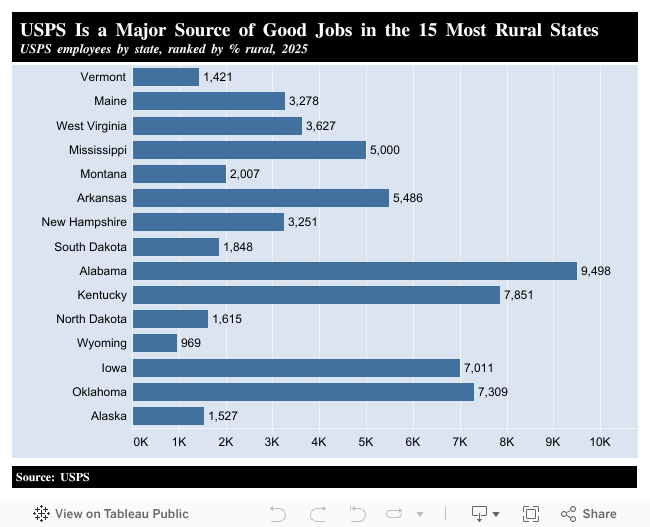
At a time of skyrocketing tuition rates and ballooning student debts, USPS is highly valued as a source of good jobs for Americans without advanced degrees. Among all U.S. workers with a high school diploma and no college, median annual pay stood at $48,360 in 2024, while the median for postal workers (across all postal occupations) is significantly higher, at $57,870.
The chart below compares median annual wage levels in the 15 rural states for the three major postal occupations with those for the five most common occupations that do not require more than a high school diploma. In nearly every case, postal worker pay exceeds that of the other occupations, even without considering the value of postal pension benefits.
| The 15 most rural states, ranked by % rural | USPS mail carriers | USPS clerks | USPS mail sorters + processors | Retail sales | Fast food | Cashiers | Stockers and order fillers | Truck drivers |
|---|---|---|---|---|---|---|---|---|
| Vermont | $56,330 | $60,590 | $58,650 | $36,810 | $37,640 | $35,380 | $39,450 | $57,050 |
| Maine | $56,330 | $60,030 | $57,490 | $36,460 | $35,360 | $33,690 | $39,430 | $53,960 |
| West Virginia | $55,540 | $61,630 | $57,490 | $27,910 | $27,130 | $25,390 | $34,340 | $51,920 |
| Mississippi | $53,600 | $59,550 | $55,410 | $27,810 | $23,330 | $24,170 | $35,990 | $55,240 |
| Montana | $56,330 | $57,870 | $57,490 | $35,000 | $29,780 | $31,310 | $39,610 | $59,050 |
| Arkansas | $56,560 | $58,510 | $57,490 | $29,420 | $27,010 | $27,720 | $34,920 | $56,570 |
| New Hampshire | $57,470 | $61,110 | $56,450 | $35,440 | $30,800 | $31,510 | $38,220 | $59,120 |
| South Dakota | $59,320 | $57,830 | $59,550 | $34,260 | $30,390 | $30,430 | $36,130 | $58,150 |
| Alabama | $55,200 | $61,110 | $55,410 | $29,430 | $25,450 | $26,170 | $35,370 | $54,040 |
| Kentucky | $56,330 | $62,670 | $57,140 | $29,450 | $26,600 | $26,860 | $38,960 | $60,060 |
| North Dakota | $57,490 | $62,680 | $55,780 | $35,670 | $30,150 | $31,570 | $38,780 | $63,920 |
| Wyoming | $54,270 | $58,650 | $59,650 | $31,450 | $28,120 | $30,210 | $43,130 | $62,320 |
| Iowa | $57,820 | $60,590 | $59,550 | $30,030 | $28,320 | $29,440 | $38,710 | $58,350 |
| Oklahoma | $57,490 | $60,590 | $57,490 | $29,580 | $25,900 | $26,790 | $35,810 | $56,300 |
| Alaska | $54,270 | $55,720 | $55,350 | $36,940 | $32,640 | $35,940 | $43,190 | $66,890 |
| U.S. median | $57,490 | $61,630 | $56,530 | $34,730 | $30,480 | $31,190 | $37,090 | $57,440 |
Source: Institute for Policy Studies analysis of Bureau of Labor Statistics occupational employment and median wage data by state, 2024
Affordable, universal delivery of mail and packages to even the most remote addresses
Private carriers, including Amazon, UPS, and FedEx, often rely on USPS for “last mile” delivery to rural addresses because those routes are less profitable than those in densely populated cities. Rural areas account for 88 percent of the geographic area served by the Postal Service, but just 16 percent of the U.S. population.
Unlike USPS, the for-profit carriers FedEx and UPS also impose surcharges on deliveries to rural and remote areas when customers use their own packaging (as opposed to flat rate boxes). A detailed Institute for Policy Studies report found that these surcharges apply to ZIP codes that are home to 102 million Americans (about 31% of the population).
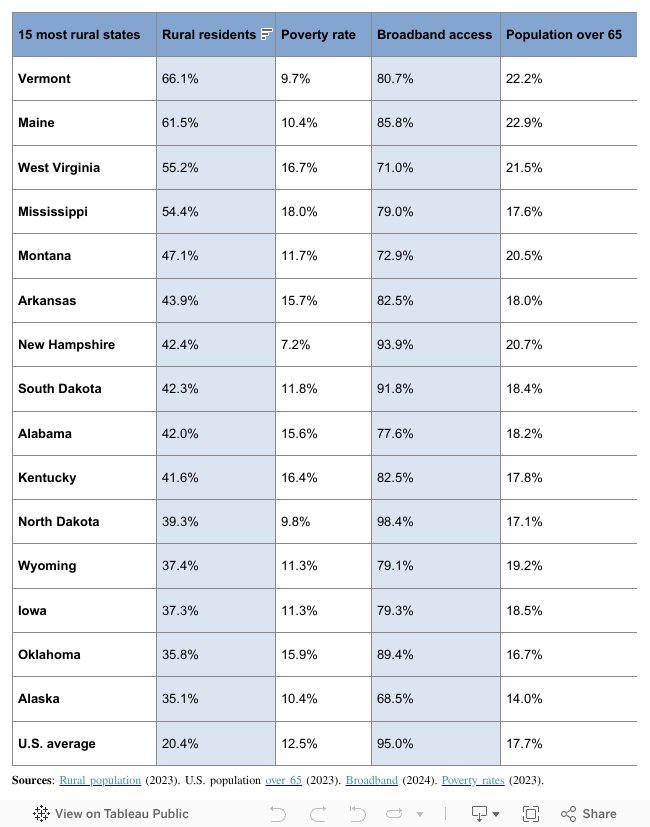
The IPS report also points out that USPS mail carriers pick up packages of less than 70 pounds from residences at no cost during their regular delivery routes. UPS fees for such pick-ups in rural areas can run more than $20, while FedEx charges $4 per package on weekdays and $16 on Saturday. Affordability is a major factor for many people in rural communities, where poverty rates run higher on average than in urban centers. Of the 15 most rural states, six have poverty rates that are significantly above the national average.
First-class mail alternative for those without broadband
In seven of the 15 most rural states, more than 20 percent of the population did not have broadband access in 2024. Only one (North Dakota) has an access rate higher than the national rate. People without high-speed broadband rely more heavily on mail service for bill-paying and other communications, from birthday cards to garden seed orders. And mailing a letter or check from Florida to Alaska still costs just 78 cents, compared to about $2.30 for a First Class stamp in the UK, which privatized its postal system in 2013.
Significant means of communication for older Americans
Of the 15 most rural states, 11 have larger than average shares of residents age 65 and older, the age group that relies most heavily on USPS. According to a USPS survey, households headed by someone 55 or older sent an average of more than 22 pieces of correspondence mail in 2024 – almost six times as much as the 18 to 34 age group. The 55+ group paid 18% of their bills by mail, compared to 7% for the younger group.
Critical delivery of medicine and other essentials
USPS delivers an estimated 1.2 billion prescription drug shipments a year. This is a vital service for rural communities, where residents are increasingly likely to live long distances from the nearest pharmacy. The number of pharmacies in rural communities declined by 5.9% between 2018 and 2023. Veterans, some 2.7 million of whom live in rural communities, receive 84 percent of their prescriptions through the mail. Aside from some medicines that require refrigeration, USPS handles nearly all of these deliveries to veterans. During the Covid-19 pandemic, USPS demonstrated its capacity to deliver medicine, food, and other essentials to a much larger swath of the U.S. population. For example, by March 2022, USPS had delivered more than 270 million Covid-19 test kits to U.S. households, with an average delivery time of just 1.2 days. Even in normal times, Alaskan villages, Maine islands, and other remote areas rely on USPS for food and other vital goods.
Vote by mail
During the 2024 general election, USPS delivered more than 99 million ballots to and from voters. Rural residents rely particularly heavily on the mail-in option, in part because polling sites are often long distances from their homes. Nationwide, half of rural county polling sites serve an area greater than 62 square miles, compared to just 2 square miles for urban sites. Vote by mail is particularly important for seniors ages 65 or older, who made up 20 percent of rural residents nationwide in 2022, compared to just 16 percent of urban residents. The elimination of mail-in ballots would have devastating implications for our democracy by impeding the civic right and duty of citizens to cast ballots.
Neighborhood watch
Letter carriers visit every U.S. address six days a week. Particularly in rural areas, they are often the first to notice signs that a resident might be in danger, from a build-up of uncollected mail to the smell of smoke or someone calling for help. USPS also offers a “Carrier Alert” service, which allows people with special needs to register to have a symbol placed on their doors, indicating that letter carriers should report any signs of distress to local social service agencies.
The privatization threat to rural communities
Some analysts and policymakers have expressed support for privatizing USPS by selling off part or all of the service to for-profit corporations. Such changes would jeopardize the many benefits of a public Postal Service for rural communities, including affordable prices, good-paying jobs, and universal service.
Higher prices: In a step-by-step guide to postal privatization, Wells Fargo analysts recommend increasing USPS parcel delivery rates by 30 percent to 140 percent to attract private investors. Without competition from a public Postal Service dedicated to affordable rates, corporations would likely raise prices even higher in rural areas — or terminate delivery service altogether.
Post office closures and job losses: Wells Fargo analysts note that USPS owns $85 billion in real estate that could be “harvested” (i.e., sold off) under a privatized system. Rural post offices, along with related post office jobs, would likely be first on the chopping block. Some 57 percent of post offices are in rural areas and while they serve a vital purpose, nearly two-thirds of them have not been profitable in recent years.
Threats to universal service: The Wells Fargo analysts and some other prominent commentators and politicians have recommended that USPS continue to operate the mail service while allowing private corporations to take over the USPS package delivery business. Stripping USPS of the most profitable – and growing – segment of the system would hollow out the Postal Service and likely lead to degrading of service. This could open the door to full-scale privatization and the elimination of universal mail delivery service.
Additional IPS postal research is available here.
Download
Subscribe to our newsletter
Further reading

Lessons from Atlanta’s Municipal Grocery Store Experiment

High Flyers 2026: The High Cost of Private Jet Excess