
Remembering Isabel Letelier, Who Turned a Tragedy into a Global Movement for Human Rights


The Institute for Policy Studies staff and board are mourning the loss of Isabel Morel De Letelier, a gentle giant of the global human rights and women’s movements who died on October 30 at age 94 in Santiago, Chile.
“Isabel modeled bravery combined with compassion,” said IPS Senior Advisor and former Director John Cavanagh. “She used this potent combination to turn a brutal international terrorist attack into a force for justice — not only for her husband, but for human rights victims around the world.”
On September 21, 1976, agents of Chilean dictator Augusto Pinochet assassinated Isabel’s husband, Orlando Letelier, and his Institute for Policy Studies colleague Ronni Karpen Moffitt in a car bombing in downtown Washington, DC. The assassins had targeted Orlando, a former Chilean ambassador to the United States and a prominent critic of the dictatorship.
Shortly after this horrific act, IPS co-founders Marcus Raskin and Richard Barnet hired Isabel to carry on the fight for justice in Chile. She ran the Institute’s Human Rights program and Third World Women’s project until she returned to Chile after that country’s transition to democracy in 1990.
Isabel leaves countless lasting legacies.

Through the IPS Human Rights program, Isabel pursued justice for the victims of Chile’s dictatorship and established the Institute’s annual Letelier-Moffitt awards program, which has lifted up more than 100 human rights champions in the United States and Latin America over the past 50 years. (A full list of honorees can be found here.)
To educate Americans about the human impacts of U.S. foreign policy, Isabel’s Third World Women’s project brought over three dozen women leaders from Chile and other Global South countries to tour the United States — from Capitol Hill to communities across the country.
As part of her education and organizing work, Isabel curated the Institute’s priceless collection of “arpilleras,” tapestries Chilean women sewed by hand during the dictatorship to express their suffering and to document the struggle for democracy. IPS has continued to exhibit these political artworks in universities and other venues over the past several decades to inspire new movements for justice and accountability.
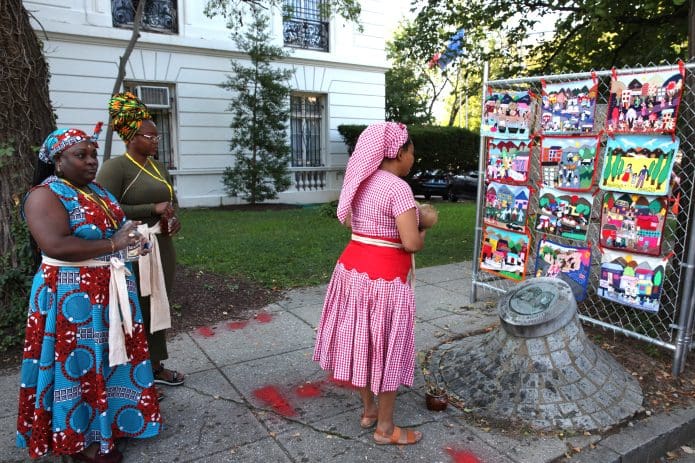
To build international solidarity for the Chilean cause, Isabel mobilized support from diverse audiences, from a Church Women United gathering in Nebraska and a labor conference in Calgary to the U.S. Senate and the UN Commission on Human Rights.
“At first, I felt embarrassed all the time that people were giving me help,” Isabel told The Guardian in 1979. “Now I ask for it without hesitation, because I know that when we get our liberation we will do the same for others. It’s something that you don’t keep. You have to give it back.”
Working with bold lawyers and relentless investigators, Isabel also used her moral authority to help achieve a number of measures of justice, including the prosecution of several perpetrators in the car bombing that killed her husband, a successful civil suit against the Republic of Chile, and the indictment of Pinochet in his home country.
In 1979, shortly before a U.S. trial of three men charged in the Letelier-Moffitt assassination, Isabel returned to her homeland for the first time since the 1973 coup and granted interviews with right-wing Chilean media.

“They wanted me to say I was embittered,” she told a reporter after her return to the United States. “They never got me to say that. I said that people who have suffered on their bodies or by losing their loved ones do not hate. They are seeking justice so this does not happen again.”
The legal efforts Isabel supported continue to bear fruit. Just this past June, a Chilean judge sentenced three former secret police agents for their role in the murder of Ronni Karpen Moffitt, the young American IPS colleague who also died in the 1976 attack.
In 2024, IPS honored Isabel at the annual Letelier-Moffitt Memorial Program at Sheridan Circle, the site of the assassination on Washington’s Embassy Row. While she was not able to travel to Washington for this event, IPS leaders presented Isabel’s family members with a book of tributes from many of her friends and fans. A video of the program is available here and the written tributes here.
A common theme of these tributes: Isabel’s relentless strength and optimism.
“When you develop negative feelings, you become something very dark,” she explained to the Times News Service in 1982. “I do believe strongly in a better society. Without being a romantic, I know that each of us can do something.”
Isabel passed on her positive approach to life and her commitment to human rights to her four sons — José, Cristian, Francisco, and Juan Pablo. After more than a half century of struggle, they and their families continue to walk hand in hand with IPS in the pursuit of justice.