Some philanthropic donors may be promising to give a lot of money to charity in order to get a nice tax break–but ultimately not delivering on the cash. The trick…
Advanced Search
Projects
Clear
Authors
Clear
Some philanthropic donors may be promising to give a lot of money to charity in order to get a nice tax break–but ultimately not delivering on the cash. The trick is the use (or perhaps abuse) of donor-advised funds, a type of savings and investment haven that allows you to set aside money for charity in order to receive the immediate tax benefits of giving to charity, but then wait to distribute that money until later on.
That’s the warning being raised by a new report from the Institute for Policy Studies, a nonprofit progressive think tank that looks at ways to ensure a more equitable, ecologically sustainable and peaceful society. In theory, the benefit of a DAF is that it allows people who want to take time to decide how best to donate their money, while also allowing the contributions to generate returns. In practice, IPS researchers have grown concerned that the money isn’t actually going to any causes; it’s just sitting there making more money, while the donors get a tax break for doing nothing. The report, entitled “Warehousing Wealth” notes that annual DAF contributions have risen to about $23 billion annually, an increase of 66% over the last five years. At the same time, only about 20% of that money is being spent on cause work.
1. Taking Another Look One morning last October, a middle-aged man named Francisco Letelier stepped to a microphone in Washington, D.C.’s Sheridan Circle, surrounded by light Sunday traffic, and spoke to a gathering of maybe a hundred people. Introducing him, the head of the watchdog Institute for Policy Studies said Letelier represented “the power of persistence.” Letelier is an artist and the son of murdered Chilean activist Orlando Letelier. The gathering to commemorate his father had become an annual event; this was the 41st year since the murders of Orlando Letelier and his American assistant, Ronni Moffitt.
Out of the European Union and into the Trans-Pacific Partnership
In a somewhat surreal twist, in what is already an increasingly surreal global landscape, UK trade minister Liam Fox announced last Wednesday, 18 July, that the government will do a public consultation on whether the UK should seek to join the Comprehensive and Progressive Agreement for Trans-Pacific Partnership (CPTPP) once the UK leaves the European Union next March. Quite rightly, many think this move is ridiculous as we are nowhere near the Pacific. The idea of Britain joining the partnership defies the logic of what is a regional trade bloc. It appears to be a desperate act by a desperate government that is making the majority in this country feel more and more apprehensive each day by its perplexing Brexit plans.
A fragile calm has taken hold in the besieged Gaza Strip as a deal between Hamasand Israel appears to be holding.
The deal, brokered by Egyptian and United Nations officials, was designed to restore calm and end the Israeli onslaught on Hamas positions and other violence that resulted in the deaths of four Palestinians and one Israeli soldier on Friday.
After years of wrangling over the rules, public companies are now disclosing their workers’ median annual pay and showing how that number stacks up against what the CEO makes.
Federal rules that took effect last year require public companies to express the pay gap between workers and the CEO in the form of a ratio. Fifty of the Pacific Northwest’s public companies have now done so, as have about 72 percent of the public companies nationwide.
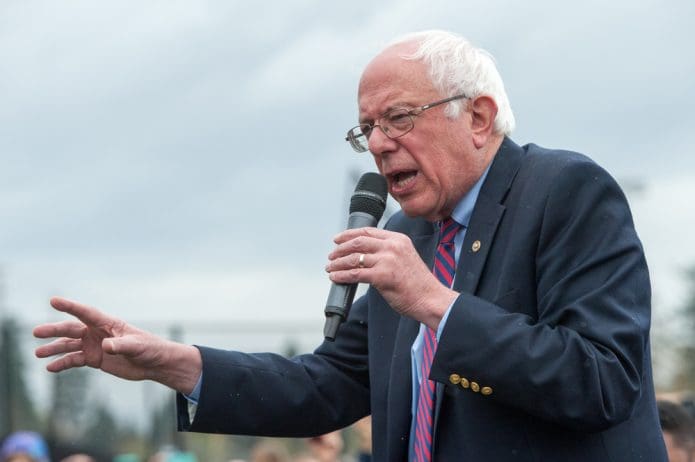
“The three wealthiest people” own “more wealth than the bottom half of the American people.”
The U.S. senator, an independent from Vermont, previously made the claim on Facebook and repeated it three days after his Wisconsin appearance in a column in USA Today.
What we found is the wealth lead enjoyed by the three billionaires is even larger than what Sanders said.
A study
Before we dig in, an important note about the nation’s wealth gap:
Many Americans make a good income, have some savings and investments, and own a nice home; they also have debt, for a mortgage, credit cards and other bills. The result is, even some people with relatively healthy incomes, as well as many poorer people, have a negative net worth.
To back Sanders’ claim, his campaign pointed us to a November 2017 news article in Forbes. The business magazine reported on a study published that month by the Institute for Policy Studies, which the article described as a left-leaning think tank in Washington, D.C.
The study, which advocates for reducing wealth inequality, also gained news coverage from USA Today and The Guardian. And its authors wrote opinion articles about it for Newsweek and the Los Angeles Times.
The numbers
The study used data from Forbes’ 2017 ranking of the 400 richest Americans; and data for the rest of the country from the 2016 Federal Reserve Survey of Consumer Finances, which the study says has become widely accepted as the most comprehensive government dataset documenting household wealth. PolitiFact has also reliedonthis Fed survey in our wealth fact checks.
The first finding the study reported was this:
The three wealthiest people in the United States now own more wealth than the entire bottom half of the American population combined, a total of 160 million people.
Those individuals and their source of wealth are, according to the study:
That’s a total of $248.5 billion. The wealth of the bottom 160 million was $245 billion, the Institute for Policy Studies’ Josh Hoxie told us. That’s a gap of $3.5 billion.
Hoxie, a former aide to Sanders, also pointed out that the wealth of the three billionaires has ballooned to $330 billion, according to Forbes’ latest estimate.
We don’t have an updated estimate for the bottom 160 million American, as the Fed survey is done only once every three years. But Hoxie said it’s nearly impossible that the wealth of Americans at the bottom has grown nearly as much as that of the three billionaires.
For the 160 million people at the bottom of the scale, by the way, the study used the net worth figure reported by the Fed and then subtracted automobiles and other “durable goods” such as electronics, furniture, and household appliances, from that figure.
Subtracting durable goods from net worth “offers us a more accurate depiction of household wealth as these items are not easily sellable and neither appreciate nor hold constant their value,” the study says.
Other viewpoints
More fact checks on wealth inequality
Michael Moore, in 2011: “Just 400 Americans — 400 — have more wealth than half of all Americans combined.” True.
One Wisconsin Now, in 2013: “The Walton family, which owns Wal-Mart, controls a fortune equal to the wealth of the bottom 42 percent of Americans combined.” True.
Starbucks, in 2015: “White people control almost 90 percent of the nation’s wealth.” True.
The study’s methodology is sound and its conclusion cited by Sanders is accurate, according to Abdur Chowdhury, an emeritus economics professor at Marquette University in Milwaukee, and economics professor Emmanuel Saez, director of the Center for Equitable Growth at the University of California, Berkeley.
As an aside, we’ll note that Saez also said Sanders’ claim is “somewhat meaningless.”
“The meaningful thing to say,” Saez told us, “is the bottom half of the U.S. families owns essentially no wealth on net, because debts cancel out whatever small assets they may have, on average.”
Our rating
Sanders says: “The three wealthiest people” own “more wealth than the bottom half of the American people.”
The wealth of Gates, Bezos and Buffett exceeded that of the 160 million at the bottom of the scale, according to a 2017 study. And more recent estimates indicate the wealth of the three has since grown dramatically, widening the gap even more.
“The three wealthiest people” own “more wealth than the bottom half of the American people.”
The U.S. senator, an independent from Vermont, previously made the claim on Facebook and repeated it three days after his Wisconsin appearance in a column in USA Today.
What we found is the wealth lead enjoyed by the three billionaires is even larger than what Sanders said.
I can’t decide which is more embarrassing for our country: President Donald Trump buddying up to North Korea’s Kim Jong Un, or Trump praising Russia’s Vladimir Putin for being “strong” in his denial of election meddling. A recent cartoon shows Kim and Putin sharing stories about how easy it is to fool our self-absorbed, easily flattered excuse for a president.
Elon Musk jumped into a scandal of his own making last week when he called a British cave diver who was instrumental in the rescue of a dozen Thai boy scouts from a flooded cave a “pedophile.” When called to task over the comment, he doubled down and repeated it.
Now shares of his company, the automaker Tesla, have fallen 16 percent. And attorneys believe the aggrieved cave diver has a strong defamation case against the billionaire. Brian and John speak with Sam Pizzigati, a veteran journalist and an associate fellow at the Institute for Policy Studies, where he specializes in economic inequality issues, and is the author of the new book “The Case for a Maximum Wage.”
In what has been a recurring cycle, a slew of gun-related violence in D.C. and subsequent conversations about public safety have spurred calls from residents and council members alike to flood the most affected communities with police officers and confiscate as many firearms as possible.
Long before that strategy proved controversial in a June stop-and-frisk scandal involving the Metropolitan Police Department’s (MPD) gun-recovery unit, some residents and activists have pushed against the prevailing school of thought, organizing around legislation that provides resources for residents in place of arrest and prosecution.