FACT SHEET: Federal Policy Threatens Women and Children with Poverty


Introduction
Women and children in the United States are under enormous economic strain. According to the most robust measure of poverty, the Supplemental Poverty Measure, nearly 13.6 percent of women and 13.4 percent of children lived in poverty in 2024.
Among those, Black, Latinx, and Native American populations are at the greatest risk of being impoverished. Over 21 percent of Black and Latina women lived in poverty, compared to 8.4 percent of non-Hispanic white men. And over a quarter of families headed by single women with children live in poverty.
Over the past decade, the number of women and children eligible for food and nutrition assistance programs has increased. More than half of the beneficiaries are children. Homelessness in the U.S. is at a record high, and women are seeing a steep increase at nearly 20 percent since 2023. Families with children saw the biggest increase of any group as homelessness increased by nearly 40 percent from 2023 to 2024.
These levels of poverty are a result of policy choices.
In 2021, COVID-19 pandemic relief programs achieved a record-low poverty rate of 7.8 percent. These policies and programs worked, and they helped vulnerable populations, especially children. With the expansion of the Child Tax Credit through the American Rescue Plan, along with other governmental relief, child poverty also saw a record low rate of 5.2 percent.
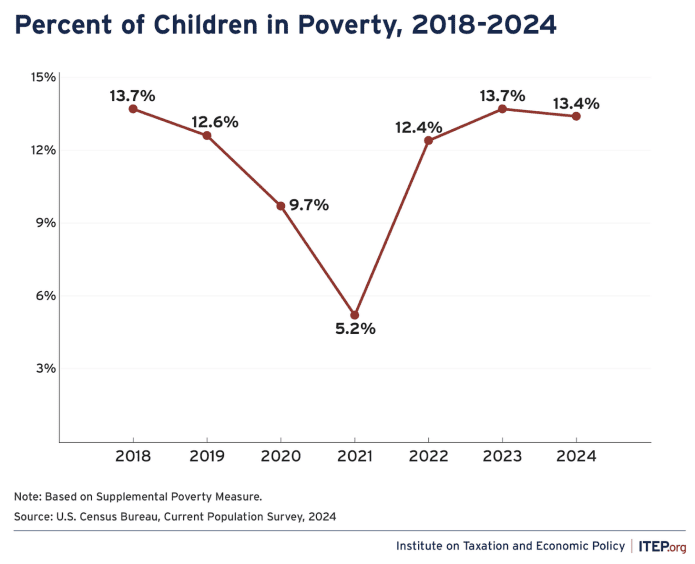
But these beneficial, pandemic-era programs were allowed to expire, spiking overall poverty, child poverty, increasing food insecurity, and housing instability. This spike was particularly sharp for those who benefited most, including Black women.
Programs geared towards income transfers, food provisions, housing, and health care showed an improvement in overall child well-being, especially for Black and Latinx children. These policies helped alleviate many structural, economic obstacles for women and children. But these gains have been eroded over the past four years and face greater threats because of the Republican-passed legislation, the so-called “One Big Beautiful Bill” or HR.1.
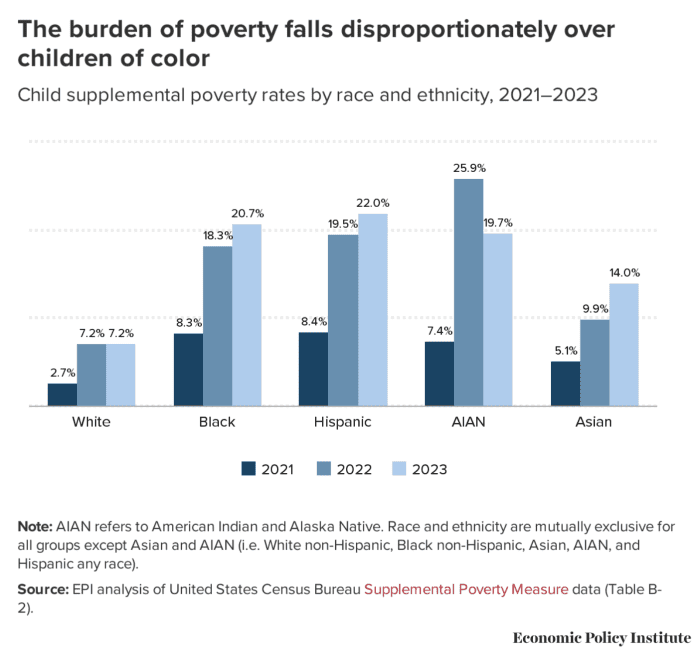
In its most recent poverty report, the U.S Census Bureau showed that overall poverty remained statistically unchanged in 2024, at 12.9 percent. However, since the poverty-reducing programs of 2021 expired, the overall poverty rate has increased from 8 percent back to nearly 13 percent in 2024. Child poverty more than doubled from 2021’s 5.2 percent to 2024’s 13.4 percent.
The Trump administration continues to enact harmful policies, like those contained in HR.1, which make massive cuts to education, health care, food assistance, and housing programs, to give tax cuts to the rich. The poverty rate is bound to continue to increase in the next few years. As a result, women and children will face increasing vulnerability.
This report examines the threats that women and children face regarding education, food assistance, healthcare, and housing, as well as the impact of current and proposed policies.
Threats to Education
Nearly 50 million children in the United States are enrolled in public schools. But public education is under threat as the Trump administration is pushing a system that privileges private education. From funding cuts and budget freezes at the Department of Education to a private school voucher program that funnels public school funds to private schools, millions of children will face educational challenges.
- School voucher programs will disproportionately harm low-income and rural communities, as public school funds will be redirected to private schools. This will result in cuts to public education resources and opportunities for millions of children.
Along with public education, over 21 million students receive free or reduced-price school meals, which are directly tied to the Supplemental Nutrition Assistance Program (SNAP).
Other public educational programs include Head Start, a government-funded early learning development program that supports low-income families with children under five. Children enrolled in Head Start programs, predominantly from Latinx and Black families, are provided with many benefits, such as health insurance, housing assistance, job training, prenatal education, and services for children with disabilities.
- Over 90 percent of the children and families that participate in Head Start programs live below the poverty threshold. With the elimination of these programs, many impoverished families could lose access to affordable or free childcare.
There have also been massive layoffs at the Office of Special Education and Rehabilitative Services, which ensures that states comply with the Individuals with Disabilities Education Act, a law that makes public education available for children with disabilities and special needs. These layoffs will take away essential safeguards and programs from 7.5 million children and students with disabilities.
Drastic cuts to these programs threaten the academic success and freedom of millions of America’s most vulnerable youth. More school-age children and infants will come to school hungry, sick, or without the developmental support they need to thrive.
Threats to Food Assistance
Over 41 million Americans receive benefits through the Supplemental Nutrition Assistance Program, a food assistance program also referred to as SNAP and/or food stamps. SNAP provides benefits to low-income individuals and families in order to afford the necessary foods for good health and well-being.
In 2022, women were over half of all SNAP beneficiaries. And in 2023, children were 40 percent of SNAP beneficiaries.
SNAP is essential in reducing food insecurity and hunger and has kept millions of people out of poverty, including children, seniors, people with disabilities, and people of all racial and ethnic backgrounds. It has also been linked to better educational outcomes for children as well as better health outcomes for both women and children.
The historic cuts to SNAP under HR.1 will harm the health and well-being of over 40 million people, including 16 million children. Among these individuals, Black, Latinx, Native American, and Pacific Islanders will be disproportionately harmed due to these cuts.
- Black, Latinx, and Native American children are at the greatest risk of losing SNAP benefits due to HR.1 cuts. These cuts will increase food insecurity and health issues for these youth.
- SNAP is shown to be beneficial in health outcomes for children. SNAP cuts could put many children at risk of chronic diseases like malnutrition and obesity, as well as experience long-term developmental issues.
- The Special Supplemental Program for Women, Infants, and Children, or WIC, eligibility depends on SNAP and Medicaid benefits. When populations lose SNAP and Medicaid benefits, they also lose WIC benefits. Cuts to SNAP and Medicaid will result in hundreds of thousands of infants and young children losing WIC.
Threats to Health Care
Medicaid provides millions of low-income Americans with health coverage. The “One Big Beautiful Bill,” HR.1, slashes Medicaid by more than $900 billion. The Children’s Health Insurance Program (CHIP), part of Medicaid, provides health coverage for nearly half of U.S children. In the next decade, over 10 million people will lose their health insurance, and these cuts will drastically affect women and children nationwide.
Cuts to Medicaid and CHIP will create eligibility barriers for other governmental services such as the Special Supplemental Nutrition Program for Women, Infants, and Children (WIC) and Head Start programs.
These budget cuts will not only directly impact Medicaid and CHIP recipients, but all Americans. Hundreds of rural hospitals and health centers that serve Medicaid and CHIP recipients could see an increase in closures, making it harder for many Americans to access readily available health services.
- School-based health services funded through Medicaid, such as vision and hearing screenings, speech therapy, and behavioral health services, are at risk of being taken away. Medicaid cuts could significantly affect essential health services for children in schools, especially those with disabilities.
- Nearly 41 percent of children living in rural areas receive Medicaid and/or CHIP benefits. With over 700 rural hospitals at risk of closure, and over 300 are at immediate risk of closure due to Medicaid cuts, children in rural areas are at risk of losing access to essential health services.
- Lawfully present immigrants, including survivors of trafficking and domestic violence who are eligible for Medicaid, will lose access to health care.
HR.1 also de-funds Planned Parenthood, putting nearly 200 Planned Parenthood health centers be at risk of closure. Over 90 percent of these closures are in states where abortion is legal, resulting in over one million patients losing access to reproductive and essential care.
- At the state level, nearly 63 million women and girls of reproductive age live in states where access to abortion and other reproductive health services is either gone or significantly eroded.
- And over 40 percent of trans youth live in states where laws or policies restrict gender affirming care.
Threats to Housing
According to the Department of Housing and Urban Development (HUD), to experience homelessness means to lack a fixed, regular, and adequate nighttime residence. In 2024, homelessness among families with children and unaccompanied youth reached record levels.
HUD provides many programs and services that alleviate homelessness among vulnerable populations, but with funding limitations, these programs only reach 25 percent of eligible families. Nearly 2.3 million families rely on Housing Choice Vouchers, which provide funding to public housing agencies to help low-income families afford housing.
With limited funding already, the current administration is considering adding new restrictions to federal housing programs, which could result in nearly 4 million people losing federal housing assistance.
- Funding for Emergency Housing Voucher programs could be depleted by 2026, even though it was slated to provide funds till 2030. This could result in nearly 60,000 families, mostly those with children, facing immediate homelessness.
Conclusion
Poverty in the U.S. is a result of policy choices. The poverty-alleviation programs during the COVID-19 pandemic demonstrated how poverty can be drastically reduced by supporting human needs for everyone — no matter where they live or what they look like.
When children grow up with proper nutrition, health care, quality public education, and safe and accessible housing, they do better for a lifetime. Education programs like Head Start and free and reduced school lunch improve cognitive development, increase test scores, and graduation rates. Nutrition programs like SNAP and WIC have been shown to reduce food insecurity among low-income families. Similarly, health care programs such as Medicaid and CHIP expand access to essential medical services and contribute to improved overall health outcomes.
Whole communities and the national economy benefit when everyone is doing well, with equal opportunities to thrive. But now, critical funding for beneficial programs and government agencies are being slashed. This is the wrong direction for our families, our economy, and our country.
A lesson from the COVID-19 pandemic is that we know what policies reduce poverty — and we know that poverty spikes without them. We must not go backwards. We must reinstate and build on policies that work.
Only then can we do right by our families, our communities, and our nation.
Reyanna James contributed fact checking to this report.
Subscribe to our newsletter
Further reading
What Could Indianapolis Fund Instead of Giving Big Tech $395 Million in Tax Breaks for Data Centers?

FACT SHEET: Voter Suppression and the 2026 Midterms