
Reports
Note: these reports are Adobe Acrobat PDF documents, which are easy to print and share but require PDF reader software to open. Mac OSX users can open PDF's natively. Microsoft Windows users who do not already have the software installed may need Acrobat Reader. It is a free download.
2008: World Bank: Climate Profiteer | The Unfinished Business of Nuclear Disarmament | 40 Years Later: The Unrealized American Dream | Risky Appropriations: Gambling U.S. Energy Policy on the Global Nuclear Energy Partnership | Iraq Quagmire: Costs of War | The Iraq War: The Costs to States | Nuclear Power in the Age of Global Warming | Iran in the Crosshairs: How to Prevent Washington's Next War | Analysis: U.S. Department of Energy Budget FY 2009 | Military vs. Climate Security | State of the Dream 2008
2007: Wal-Mart’s Sustainability Initiative: A Civil Society Critique | Strategic Corporate Initiative | Executive Excess 2007 | Just Security | A Unified Security Budget for the United States, FY 2008 | Radioactive Wastes and the Global Nuvlear Energy Partnership | Selfish Interest | Challenging Corporate Investor Rule
2006: Executive Excess 2006 | Debt Boomerang
2005: Executive Excess 2005 | AFTER the FTAA: Lessons from Europe for the Americas | Wal-Mart's Pay Gap
April 10, 2008
Featured in:
- Bloomberg on April 10, 2008
- BusinessGreen on April 10, 2008
- Foreign Policy In Focus on April 10, 2008
- Inter Press Service on April 10, 2008
- OneWorld US on May 6, 2008
By Sustainable Energy and Economy Network
Author(s): Janet Redman
After years of waning global influence, the World Bank has attached itself to the climate crisis like a patient on life support. Facing a crisis of legitimacy over its failed economic policy proscriptions and long track record of boondoggle projects, the aging institution is attempting to give itself a makeover. No longer is it just the Bank whose “dream is a world free of poverty.” Now it is the Bank that can solve the climate crisis. The facelift includes a $2 billion portfolio of trust funds that channel carbon finance – money used to buy cuts in greenhouse gas emissions from projects in developing countries – from polluting industrialized countries in the global North to some of the most ecologically destructive industries in the global South.
This report exposes the World Bank for what it is – and names it as such – a “climate change profiteer.” The World Bank irresponsibly and recklessly continues to perpetuate the world’s dependence on climate-altering fossil fuels while profiting from carbon trading, which is a dubious remedy to climate change.
April 3, 2008
The Unfinished Business of Nuclear Disarmament
Author(s): Robert Alvarez
The legacy of the Cold War nuclear arms race remains a danger to the world. The United States and Russia are still possess tens of thousands of intact nuclear warheads with no clear plans for their dismantlement. Meanwhile, efforts to control the global spread of nuclear weapons are being undermined by the radical Bush Administration policy authorizing preemptive nuclear attacks against nations that may be seeking to acquire nuclear weapons.
Both Republican and Democratic Congresses have consistently rejected proposals to design and build new nuclear weapons. Also, Congress has convened two separate panels to conduct a "Nuclear Posture Review" that outlines future nuclear weapons policies. There appears to be growing sentiment, particularly among House members of the Armed Services Committee in reducing the U.S. nuclear arsenal to 500 active and 500 reserve weapons.
The only verifiable nuclear arms agreement still in force is the Strategic Arms Reduction Treaty (START I). However, The expiration of the START I Treaty in 2009 will become an important benchmark for the future of nuclear arms reductions.
The Nuclear Non-Proliferation Treaty Review Conference in 2010 provides an important opportunity for the United States to take bold steps in reducing nuclear arms.
Restructuring the U.S. government’s programs will be required to meet NPT policy goals.
April 2, 2008
Featured in:
- Black Star News on April 1, 2008
- Democracy Now! on April 10, 2008
- The Charlotte Observer on April 4, 2008
- The Ft. Worth Star-Telegram on April 4, 2008
- The Huffington Post on April 4, 2008
- The Louisiana Weekly on April 14, 2008
- The Rutland Herald (Rutland, VT) on April 4, 2008
- The Seattle Post-Intelligencer on April 3, 2008
- The Tennessean on April 4, 2008
- The Washington Post on April 5, 2008
- Voice of America on April 4, 2008
40 Years Later: The Unrealized American Dream
By Inequality and the Common Good
Author(s): Dedrick Muhammad
Dr. Martin Luther King recognized that the next phase in the African-American’s quest for civil rights and equality was one that would focus on the economic divide between the wealthiest Americans, the working class, and those in poverty. King’s analysis of economic inequality as the foundation of racial inequality remains as valid today as it was 40 years ago.
40 Years Later: The Unrealized American Dream examines the progress in and challenges to economic equality between African Americans and whites since April 4, 1968 using data from the US Census Bureau, the Economic Policy Institute, the Survey of Consumer Finances, and other sources. Findings conclude that despite educational advances, economic equality for African Americans is still a dream, not a reality.
Watch Dedrick Muhammad speaking about 40 Years Later: The Unrealized American Dream on YouTube
March 31, 2008
Risky Appropriations: Gambling U.S. Energy Policy on the Global Nuclear Energy Partnership
Author(s): Robert Alvarez
The Global Nuclear Partnership (GNEP) is a major element of the Bush Administration’s energy policy. Its principal goal is to expand the world-wide growth of nuclear energy as a means of reducing greenhouse gas emissions and fostering economic development. Under Bush's plan, the United States and its nuclear partners would sell power reactors to developing nations who agree not to pursue technologies that would aid nuclear weapons production, notably reprocessing and uranium enrichment.
To sweeten the deal, the United States would take highly radioactive spent fuel rods to a recycling center in this country. The foreign reactor wastes, along with spent fuel from the U.S. reactor fleet, would be reprocessed to reduce the amount that would go deep underground. Nuclear explosive materials, such as plutonium, would also also be separated and converted to less troublesome isotopes in a new generation reactors operated in the United States.
However, our investigation found that:
- GNEP is a rushed, ill-conceived, poorly supported and technically and economically risky expansion and redirection of the nuclear industry. None of the technologies and processes proposed for GNEP current exist in commercially viable applications and only a few have been demonstrated in large, engineering scale projects.
- Even if its unproven technologies are shown to be viable, GNEP also has the potential to inhibit the adoption of more reasonable solutions to global climate change by diverting resources into an unproven and, most likely, a prohibitively expensive nuclear option.
- GNEP also would increase the danger of nuclear proliferation and the potential for weapons grade materials falling into the hands of hostile or unstable nations and terrorist groups.
- GNEP will likely worsen the radioactive waste disposal problem and would also make the United States the dumping ground for nuclear wastes from the other participating nations.
March 27, 2008
Author(s): Erik Leaver, Jenny Shin
The Iraq War was based on lies from before it began. Today the cost is evident in the more than 1 million Iraqi civilians dead, at least 4,000 U.S. troops dead, and a financial cost to the U.S. of over 3 TRILLION dollars. The figures are shocking because much of the reality is hidden: the flag-draped coffins are hidden from television cameras. The Iraqi dead remain unmentioned. The financial cost remains hidden because taxes have not been raised, taxes for the rich have been cut, and most importantly the war is being paid for on a credit card -- which generations into the future will have to pay. This two-page fact sheet documents an overview of the human , financial and social costs.
March 17, 2008
The Iraq War: The Costs to States
Author(s): Erik Leaver, Jenny Shin
Five years ago, the Bush administration launched what may become the greatest foreign policy disaster of this country’s over 200 years of history, and today we stand on the threshold of the 4,000th American killed, the 30,000th American tragically wounded, and the millionth Iraqi dead.
These latest fact sheets outline the costs of this war to all 50 states and the District of Columbia to help illustrate the local costs of the war. It is designed for duplication and popular education.
March 1, 2008
Nuclear Power in the Age of Global Warming
Author(s): Robert Alvarez
Nuclear energy has its origins in the scientific discoveries of the early and mid 20th century. By the end of World War II in 1945 the development of the first nuclear weapons by the United States had laid the foundation for nuclear power.
Currently, nuclear energy is responsible for 19 percent of U.S. electricity generation. By the late 1970's, however, orders for nuclear power ceased because of skyrocketing costs, accident concerns and unresolved nuclear waste disposal problems.
In the past several years, there has been renewed interest in nuclear energy as a means to mitigate the impacts of global warming due to carbon emissions. An expansion of nuclear power to effectively mitigate greenhouse gas emissions would be prohibitively expensive and risky, requiring at least 1,000 reactors over the next 45 years. It also would be an extremely slow process, taking decades to achieve any reductions in world CO2 emissions, if, indeed, it ever does. This would be a much longer time frame than implementing energy efficiency measures, distributed generation, or renewable alternatives, such as wind. Such a massive expansion of nuclear power also would divert capital resources from investments in other faster and more easily deployed alternatives for reducing world CO2 emissions.
Iran in the Crosshairs: How to Prevent Washington's Next War
Author(s): Phyllis Bennis
Contributor(s): John Cavanagh, Farrah Hassen, Erik Leaver, Saif Rahman
As George W. Bush’s administration enters its last year in office, the danger of a U.S. military attack on Iran looms. Widening opposition to the illegal Iraq War, growing recognition that the war in Afghanistan has failed to bring stability or democracy to that beleaguered country, new tensions rising in Pakistan, escalating violence and humanitarian crisis in the Israeli-occupied Palestinian territories, all have brought new fears but also heightened interest in the wider Middle East region, especially interest in Iran. It is to address this new and renewed interest in Iran, to answer questions, and propose some ideas to prevent another looming disaster, that this pamphlet is designed.
February 7, 2008
Analysis: U.S. Department of Energy Budget FY 2009
Author(s): Robert Alvarez
Despite extraordinary dependence on foreign oil, the U.S. Department of Energy’s (DOE) 2009 budget does little to find alternatives. Instead, the Bush Administration's single largest funding priority for the Energy department is to maintain a large, oversized nuclear arsenal and to build new weapons. The imperative to maintain DOE’s large and antiquated nuclear infrastructure is a major impediment to achieving a balanced and sound national energy policy.
January 31, 2008
Featured in:
- AlterNet on January 31, 2008
- Brattleboro Reformer on February 6, 2008
- Climate Change Action on February 1, 2008
- Daily Estimate on January 31, 2008
- Daily Kos on February 2, 2008
- EnerPub on January 31, 2008
- Grist on January 31, 2008
- Inter Press Service on January 31, 2008
- McClatchy on February 4, 2008
- The Daily Trojan on February 5, 2008
- Time on April 18, 2008
Author(s): Miriam Pemberton
Accepting his Nobel Peace Prize, Al Gore called on the nations of the world to mobilize to avert climate disaster “with a sense of urgency and shared resolve that has previously been seen only when nations have mobilized for war.”
This report measures in fiscal terms how far our own nation has to go to reach that goal.
January 15, 2008
Featured in:
- Democracy Now! on January 17, 2008
- National Public Radio on January 15, 2008
- The South Florida Times on March 28, 2008
- The Washington Post on February 10, 2008
By Inequality and the Common Good
Author(s): Brenda Cotto-Escalera, Anisha Desai, Jeannette Huezo, Dedrick Muhammad, Amaad Rivera
To commemorate the 79th birthday of Dr. Martin Luther King Jr. the Institute for Policy Studies and United For A Fair Economy co-sponsored a forum on the new report The State of the Dream: 2008. This report focuses on the historic racial wealth divide, what progress has been made in bridging this divide since the death of Dr. King, and the impact of our contemporary subprime housing crisis on this divide.
September 11, 2007
Wal-Mart’s Sustainability Initiative: A Civil Society Critique
Editor(s): Sarah Anderson.
Nearly two years ago, Wal-Mart CEO H. Lee Scott announced a bold initiative to turn the world’s largest company green. A long-anticipated fi rst progress report on these sustainability goals is expected to be released soon.
In advance of the company’s report, 23 environmental, farm, labor, and other civil society groups have offered their own critiques of Wal-Mart’s approach to sustainability. Some of these critiques focus on specific Wal-Mart commitments and offer recommendations for change. Others argue that even if Wal-Mart achieved all of its stated goals, the company’s business model makes it inherently unsustainable. All of them remind us of what’s at stake by demonstrating Wal-Mart’s huge and often devastating impacts on real people and places in the United States and around the world.
September 1, 2007
Strategic Corporate Initiative
Author(s): Sarah Anderson, John Cavanagh, Chuck Collins, Charlie Cray, Marjorie Kelly, Mari Margill, Michael Marx
There are tectonic stresses building beneath the surface of our society that threaten a global earthquake unlike any we’ve seen in recent history. Global warming is accelerating; fossil fuels are being rapidly exhausted; critical eco-systems have been severely damaged; and the income gap between rich and poor is increasing rapidly. The root cause of most of these problems can be found in the excessive power of global corporations. To solve these problems, we must bring corporations back under our control. This will be one of the greatest challenges our society faces this century.
August 29, 2007
Featured in:
- CNBC on August 29, 2007
- The New York Times on August 30, 2007
- USA Today on August 29, 2007
Author(s): Sarah Anderson, John Cavanagh, Chuck Collins, Mike Lapham, Sam Pizzigati
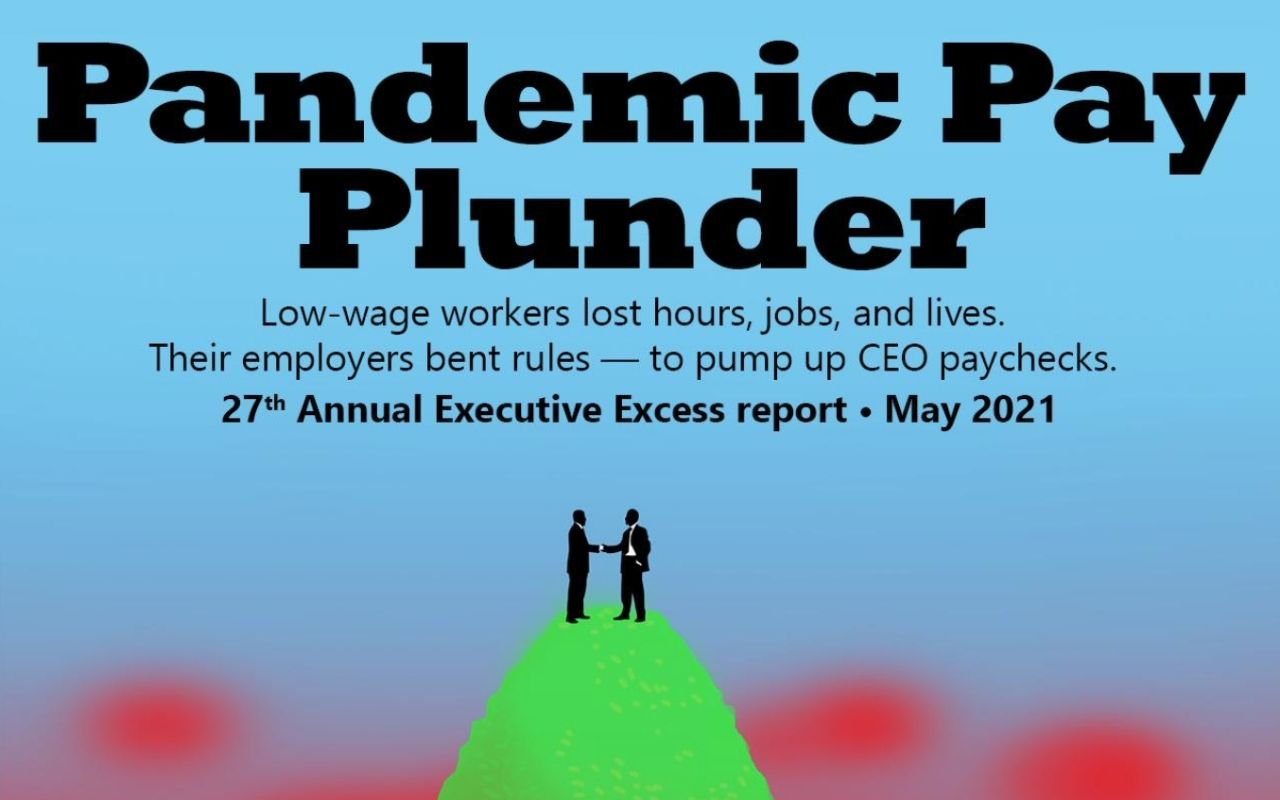
Back around 1980, big-time corporate CEOs in the United States took home just over 40 times the pay of average American workers. Today’s average American CEO from a Fortune 500 company makes 364 times an average worker’s pay and over 70 times the pay of a four-star Army general. Another example of this growing leadership pay gap: Last year, the top 20 earners in the most lucrative corner of America’s business sector, the private equity and hedge fund world, pocketed 680 times more in rewards for their labors than the nation’s 20 highest-paid leaders of nonprofit institutions pocketed for theirs.
Most Americans, over recent years, have become aware that business leaders make enormously more than the workers they employ. The gap between business leaders and other leaders in our society has received considerably less attention. This report, our 14th annual examination of executive excess, seeks to remedy that situation.
June 19, 2007
Featured in:
- The Asia Times on July 21, 2007
- The Nation - Editors Cut on July 26, 2007
- TomPaine.com on July 19, 2008
Author(s): John Feffer
Contributor(s): Sarah Anderson, Phyllis Bennis, Robin Broad, John Cavanagh, Steve Cobble, Anita Dancs, John Gershman, Erik Leaver, Kevin Martin, Nadia Martinez, Miriam Pemberton, Marcus Raskin, Emira Woods
Current U.S. foreign policy is unjust and breeds insecurity for all. In seeking an alternative, we should not revive the failed policies of the past. Instead, we should chart a new relationship between the United States and the world.
This alternative foreign policy framework tells five different stories about our common future and the five principal challenges we face: climate change, global poverty, nuclear weapons, terrorism, and military conflict. We address five different sets of core misconceptions and offer five interconnected prescriptions for change. We then offer a Just Security budget that would cut roughly $213 billion from the president's current defense budget request and yet make the United States safer and more secure. The concluding chapter puts the challenges facing the United States in a larger historical context and offers an integrated Just Security program.
April 26, 2007
A Unified Security Budget for the United States, FY 2008
Author(s): Lawrence Korb, Miriam Pemberton
As Congress works to balance the budget and find a solution to the Iraq crisis it must also focus on a different kind of budget balancing. Our country needs a rebalanced its security budget, one that strengthens a different kind of overall U.S. presence in the world. This budget would emphasize working with international partners to resolve conflicts and tackle looming human security problems like climate change; preventing the spread of nuclear materials by means other than regime change; and addressing the root causes of terrorism, while protecting the homeland against it. The rhetoric of these intentions must be underwritten by the resources to make them real. The overall priorities set by a Unified Security Budget must both symbolically and substantially guide the United States toward a new, more balanced foreign policy.
April 16, 2007
Radioactive Wastes and the Global Nuvlear Energy Partnership
Author(s): Robert Alvarez
The Department of Energy (DOE) is now heralding the Global Nuclear Energy Partnership (GNEP) as the fulfillment of the government’s decades-long effort to diminish the environmental footprint of nuclear byproducts so they no longer pose a public health threat. This review has found, however, that the program is likely to squander billions in taxpayer dollars on an unproven reprocessing technology that will generate unprecedented and unmanageable amounts of highly radioactive wastes without plausible disposition paths.
To reduce the amount of radioactive wastes slated for a deep geological repository, the DOE is seeking to store the vast majority of radioactive byproducts in shallow burial. Far from containing toxins, however, this proposal would pose threats to nearby water supplies. The site selected for the GNEP reprocessing facility would become a de-facto waste dump, creating unprecedented public health and security threats.
April 10, 2007
Author(s): Sarah Anderson, John Cavanagh, Chuck Collins, Charlie Cray, Sam Pizzigati
Does CEO pay in the United States need fixing? The 160 corporate CEOs who make up the Business Roundtable — the nation’s single most influential business lobbying group — don’t think so. The Business Roundtable is currently leading the corporate charge against congressional efforts to legislate new checks on executive compensation. This report shows just how much they personally stand to lose from real compensation reform.
April 1, 2007
Challenging Corporate Investor Rule
Author(s): Sarah Anderson, Sara Grusky
In Spanish: Desafiar el poder corporative de los inversionistas
This report examines how global corporations have increased their power through rules and institutions designed to provide unprecedented and sweeping protections to private foreign investors. These increasingly controversial protections are promoted by the World Bank and other international financial institutions, codified by bilateral investment treaties and free trade agreements, and enforced through international arbitration tribunals. Civil society groups – including labor, environmental and human rights groups -- have been harshly critical of these rules, charging that they elevate the narrow interests of global corporations above social and environmental goals. They have been joined by an increasing number of legislators around the world, including in the United States, who have attacked these measures as fundamentally undemocratic. And now, new political leaders, particularly in South America, are beginning to explore ways of challenging these excessive investor protections and putting forth proposals for more just trade and investment regimes.
Co-published by Food and Water Watch.
August 30, 2006
Author(s): Sarah Anderson, Eric Benjamin, John Cavanagh, Chuck Collins
This 13th annual study of executive compensation focuses on the two corporate sectors where excessive pay may be the most inexcusable, the defense industry and the oil industry. In both these sectors, windfalls from war are driving executive pay to record levels.
March 1, 2006
Author(s): Sarah Anderson
Unmanageable foreign debts are dragging down many of the most impoverished countries in the world. The impacts of these debts are most direct and life-threatening in the Global South, but they also boomerang back to undermine jobs and the environment in our own country. For people in the United States, joining the global calls for debt cancellation is the right thing to do. And as this study shows, it is also in our interest.
August 30, 2005
Author(s): Sarah Anderson, John Cavanagh, scott Klinger, Liz Stanton
This 12th annual study of executive compensation devotes a special section to pay among top defense contractors, illuminating the inequality of sacrifice in the Iraq War. The report also reviews and updates some of the most harmful pay trends of the past decade and a half, such as excessive compensation for the CEOs who are hurting workers by underfunding employee pensions or those who are straining our public services by not paying their fair share of taxes. For each trend, we have selected inductees in a CEO Hall of Shame who best symbolize these harmful pay policies.
June 1, 2005
AFTER the FTAA: Lessons from Europe for the Americas
Author(s): Sarah Anderson, John Cavanagh
Full report in Spanish: DESPUÉS del ALCA: Lecciones de Europa para las Américas
The European Union is a unique experiment in a broad approach to integration that has attempted to reduce economic and social disparities between rich and poor countries and within member nations. This report, available in English and Spanish, highlights some of the lessons from the EU experience that are relevant to the debate over integration in the Western Hemisphere.
April 15, 2005
Author(s): Sarah Anderson
This short report shows how Wal-Mart’s generous compensation for top executives contrasts sharply with the wages of the people who produced or sold the goods that earned the company $10.3 billion in profits on sales of $285 billion in 2004.


Syndicate: