EVERY TWO WEEKS
Institute for Policy Studies
RSS Feeds RSS Feeds

A few well-written words can convey a wealth of information, particularly when there is no lag time between when they are written and when they are read. The IPS blog gives you an opportunity to hear directly from IPS scholars and staff on ideas large and small and for us to hear back from you.

Trending

Archives

Blog Roll

AFL-CIO Blog
Altercation
AlterNet
AMERICAblog
Baltimore Nonviolence Center
Barbara's Blog, by Barbara Ehrenreich
Blog This Rock
Busboys and Poets Blog
CBPP
CEPR
CODEPINK's Pink Tank
CommonDreams
Counterpunch
Democracy Now!
Demos blog: Ideas|Action
Dollars and Sense blog
Economic Policy Institute
Editor's Cut: The Nation Blog
Energy Bulletin
Firedoglake
FOE International blog
Kevin Drum (Mother Jones)
The New America Media blogs
OpenLeft
OSI Blog
Political Animal/Washington Monthly
Southern Poverty Law Center
Think Progress
Truthout
YES! Magazine
US Campaign to End the Israeli Occupation

IPS Blog

Latest Entries

Page Previous 1234 • 5 • 6789 Next
Sequestration: Our Military is Due for Downsizing

February 22, 2013 ·

Sequestration wouldn't gut military

This strange animal called sequestration is certainly wreaking havoc with our customary ideological boundaries. 

If you’re an advocate, Iike I am, for revamped federal priorities that shift resources from a bloated Pentagon budget toward neglected domestic priorities, your take on this animal can’t be simple. You say cutting everything indiscriminately is a bad way to run a government (this view is nearly universal). You oppose the cuts in the domestic budget that will leave us with fewer food safety inspectors, medical researchers, Head Start teachers, and airport baggage screeners on the job. But you can reel off long lists of ways to cut waste in the Pentagon budget to the levels prescribed by sequestration, and show that these cuts will leave us completely safe.

But you also know that the whole conversation is focused on the wrong topic. It’s past time to shift this conversation away from austerity and toward investment to create jobs, as clear majorities of voters said in November was what they wanted.

Now let’s look at the Washington Post’s blogger who says he writes “from a liberal perspective,” Greg Sargent. On Wednesday he went at the Republican position on sequestration, wielding a new report from the non-partisan Congressional Research Service. The report found that the single most important cause of increased income inequality in recent years is the favored tax treatment given to capital gains and stock dividends — i.e. what the rich have used to get richer.

The Democrats, as Sargent points out, want to change this, taxing the rich and using the proceeds to replace the sequester cuts. The Republicans want to stick with sequestration and keep this favored treatment for the rich.

But all of this puts the Republicans, says Sargent, in the position of “openly conceding that the sequester will gut the military.” It’s a concession that Sargent appears to be taking at face value. Or at least not calling into question.

Gut the military? That’s what the Joint Chiefs of Staff have been saying any chance they get. Sequestration would “invite aggression,” says lingering Defense Secretary Leon Panetta. It will “put the nation at greater risk of coercion,” says the Joint Chiefs Chair, Martin Dempsey. When asked at a recent congressional hearing which nation might coerce us, though, he couldn’t say.

In fact, sequestration will not “gut” our military. Our military budget has nearly doubled since 2001. Sequestration would take it back to the level it was in 2007 — when we were still fighting two wars. Adjusted for inflation, it would leave that budget higher than its Cold War average — when we had an adversary that was spending roughly what we were on its military. Now, as Michael Cohen notes in The Guardian, the closest thing to a peer adversary we have is China, and we are spending more on research and development of new weapons than the Chinese are spending on their entire military. We spend more on our military, in fact, than the next 14 countries put together.

After the longest period of war in our history, we are due for a defense downsizing. Sequestration would create a shallower downsizing than any of the previous postwar periods since World War II. We can do this, and we should. We need the money for other things.

As sequestration threatens to confuse us all, let’s be sure to stay clear on that, at least.

A Day to Remember A Martyr

February 21, 2013 ·

photo of MLK and MalcolmThe militancy and radicalism of El Hajj Malik El-Shabazz (a.k.a. Malcolm X) has made his legacy harder to hijack by those of the status quo than that of Dr. Martin Luther King Jr., but that hijack is being attempted nonetheless. It has to be. Learning about the life and legacy of Malcolm X may be the most widely cited starting point of left politicization of youth worldwide, particularly for urban youth of color and more particularly for those of African descent. The life of Malcolm was a lesson for all, a lesson rich and nothing short of admirable. His exceptional life made him an inspiration to so many — and a threat to others.

On February 21, 1965, just when Malcolm was about to open his speech in the Audubon Ballroom in New York City, he was assassinated. That makes today the 48th anniversary of his murder. Although there is still controversy about who was behind his assassination, many things are clear.

The facts of the murder will be shared and discussed this evening from 6:00 PM to 9:00 PM in Howard University’s Blackburn Center, Room 155, at the forum, The “Black Messiah” The Life And Assassination Of Malcolm X Who Killed Him And Why? The event, spearheaded by Coalition on Political Assassinations in co-sponsorship with a host of other organization, will feature an array of extremely fitting speakers.

A fact more generally known is that President Lyndon B. Johnson and FBI Director J. Edgar Hoover deemed Malcolm’s revolutionary internationalism and domestic radicalism subversive and threatening to the U.S. government. Malcolm brought the plight of African people in the United States to the world stage, and clarified that our problems were not merely about civil rights but human rights. He wanted to take our issues to the world court, something that would have embarrassed the U.S. government as it was positing itself as the lecturer and enforcer of freedom and democracy around the world.

After returning from Africa and further solidifying his Pan-African perspective and concrete connections with leaders there, Malcolm started the Organization of Afro-American Unity (OAAU), modeled after the Organization of African Unity (OAU). This organization was meant to create a practical bridge between those on the African continent and people of African descent in the United States. As African people had been forcibly disconnected physically and mentally, this bridge reflected a profound political evolution that continued the ideals of the Garvey movement.

If in greater unity there is greater strength, Malcolm’s moves indeed represented a threat to those who preferred the continued oppression and disempowerment of African people worldwide. This made him a target of both the FBI and CIA.

Public documents now show that the FBI and its program COINTELPRO wanted to “…prevent the rise of a Black ‘messiah’ who could unify and electrify the militant Black nationalists movement. Malcolm X might have been such a messiah; he is the martyr of the movement today” (FBI Memorandum, March 4, 1968).

Exposing a hypocritical and immoral indiscretion of his former leader in the Nation of Islam (NOI), Elijah Muhammad incurred Malcolm X the dissatisfaction (to put it mildly) of Elijah Muhammad and the wrath of many of the leader’s loyal followers. This included the well known Malcolm X protégé, Louis Farrakhan, who publicly made inflammatory statements implying Malcolm should be killed for “betraying” Elijah Muhammad.

Even before Malcolm was officially out of the NOI, internal resentment against him was deliberately and calculatedly exacerbated by the FBI through fake letters sent and made to seem as though they were internally written. This was a common practice against organizations targeted by COINTELPRO. After Malcolm left the NOI the FBI, in coordination with the NYPD, was able to assign undercover agent Gene Roberts to infiltrate the new organization formed by Malcolm and work his way up to becoming Malcolm’s body guard. Roberts was to later do the same thing to the Black Panther Party in New York, which revealed his true identity 6 years after Malcolm’s assassination in a trial to railroad the Panther 21 into prison for allegations of plots to commit terrorist attacks.

Initially very critical of Dr. Martin Luther King Jr., Malcolm eventually gained respect and admiration for Dr. King and began a dialogue about how they could begin combining forces. They had even gone as far as to agree that Dr. King would work on galvanizing his strength and influence in the South, while Malcolm would work on the North, to in time bring both forces together. While the FBI maintains that there was no direct order given by it to assassinate these two great leaders, it is folly not to contextualize their culpability. The FBI's surveillance, meddling, and instigation of lethal tensions around the lives of the most respected and high profile leaders of the time is undisputed. These were leaders they considered a threat to national security and wanted “neutralized.”

But while murdering Malcolm deprived us of anything more he could give in life to the struggle, it also resulted in either unintended or unavoidable consequences for his adversaries. Malcolm's life and legacy continue to be an inspiration for so many young people the world over and seems to grow with each passing generation.

As Marcus Garvey said, “You can kill the lion, but what will you do about the cubs?”

This Week in OtherWords: February 20, 2013

February 20, 2013 ·

This week in OtherWords, Donald Kaul puts the brutality of drone warfare into historical context, Jill Richardson explains why you should compost and replace your lawn, and Jim Hightower says that a $9 minimum wage would still be too low.

Below you’ll find links to our latest work. If you haven’t already subscribed to our weekly newsletter, please do. 

  1. These Laws Make Me Want to Gag / Will Potter
    States are adopting laws meant to keep consumers in the dark about where their food comes from.
  2. Presidential Distortion / Peter Hart
    The message we’ve been hearing from the mainstream media about Obama’s push for a renewed brand of liberalism is flagrantly false.
  3. New World Disorder / Donald Kaul
    Modern warfare is an exercise in savagery.
  4. Segregation 2.0 / Sam Pizzigati
    America’s residential divide now goes beyond race.
  5. Lose Your Lawn / Jill Richardson
    Turning your lawn into something more beautiful and useful would save time and money while curbing pollution and water usage.
  6. Putting Some Real Pop in Populism / Jim Hightower
    Washington should do more than the minimum on minimum wage
  7. Downwardly Mobile Nation / William A. Collins
    America’s working class has been magically transformed into the working poor.
  8. Minimum Wage, Maximum Drama / Khalil Bendib cartoon

     Minimum Wage, Maximum Drama, an OtherWords cartoon by Khalil Bendib

     
February 15, 2003. The Day the World Said No to War.

February 15, 2013 ·

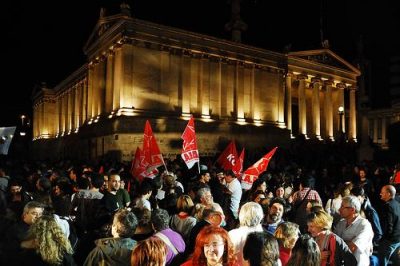
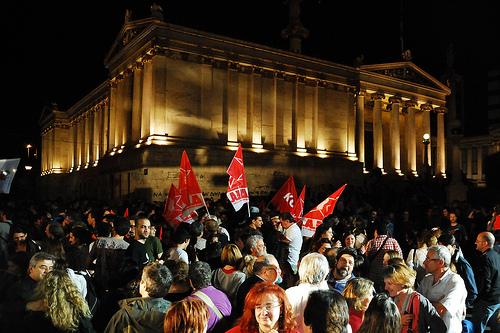
Antiwar Protests 2003 - LondonTen years ago people around the world rose up. In almost 800 cities across the globe, protesters filled the streets of capital cities and tiny villages, following the sun from Australia and New Zealand and the small Pacific islands, through the snowy steppes of North Asia and down across the South Asian peninsula, across Europe and down to the southern edge of Africa, then jumping the pond first to Latin America and then finally, last of all, to the United States.

And across the globe, the call came in scores of languages, “the world says no to war!” The cry “Not in Our Name” echoed from millions of voices. The Guinness Book of World Records said between 12 and 14 million people came out that day, the largest protest in the history of the world. It was, as the great British labor and peace activist and former MP Tony Benn described it to the million Londoners in the streets that day, “the first global demonstration, and its first cause is to prevent a war against Iraq.” What a concept — a global protest against a war that had not yet begun — the goal, to try to stop it.

It was an amazing moment — powerful enough that governments around the world, including the soon-famous “Uncommitted Six” in the Security Council, did the unthinkable: they too resisted pressure from the United States and the United Kingdom and said no to endorsing Bush’s war. Under ordinary circumstances, alone, U.S.-dependent and relatively weak countries like Angola, Cameroon, Chile, Guinea, Mexico and Pakistan could never have stood up to Washington. But these were not ordinary circumstances. The combination of diplomatic support from “Old Europe,” Germany and France who for their own reasons opposed the war, and popular pressure from thousands, millions, filling the streets of their capitals, allowed the Six to stand firm. The pressure was fierce. Chile was threatened with a U.S. refusal to ratify a U.S. free trade agreement seven years in the making. (The trade agreement was quite terrible, but the Chilean government was committed to it.) Guinea and Cameroon were threatened with loss of U.S. aid granted under the African Growth & Opportunity Act. Mexico faced the potential end of negotiations over immigration and the border. And yet they stood firm.

The day before the protests, February 14, the Security Council was called into session once again, this time at the foreign minister level, to hear the ostensibly final reports of the two UN weapons inspectors for Iraq. Many had anticipated that their reports would somehow wiggle around the truth, that they would say something Bush and Blair would grab to try to legitimize their spurious claims of Iraq’s alleged weapons of mass destruction, that they would at least appear ambivalent enough for the U.S. to use their reports to justify war. But they refused to bend the truth, stating unequivocally that no such weapons had been found.

Following their reports, French Foreign Minister Dominique de Villepin responded with an extraordinary call, reminding the world that “the United Nations must remain an instrument of peace, and not a tool for war.” In that usually staid, formal, rule-bound chamber, his call was answered with a roaring ovation beginning with Council staff and quickly engulfing the diplomats and foreign ministers themselves.

Security Council rejection was strong enough — enough governments said no — that the United Nations was able to do what its Charter requires, but what political pressure too often makes impossible: to stand against the scourge of war. On the morning of February 15, just hours before the massive rally began at the foot of the United Nations, the great actor-activist Harry Belafonte and I accompanied South African Archbishop Desmond Tutu to meet with then-Secretary-General Kofi Annan on behalf of the protesters. We were met by a police escort to cross what the New York Police Department had designated its “frozen zone” — not in reference to the bitter 18 degrees or the biting wind whipping in from the East River, but the forcibly deserted streets directly in front of UN headquarters. In the secretary-general’s office on the 38th floor of the United Nations, Bishop Tutu opened the meeting, looking at Kofi across the table and said, “We are here today on behalf of those people marching in 665 cities all around the world. And we are here to tell you, that those people marching in all those cities around the world, we claim the United Nations as our own. We claim it in the name of our global mobilization for peace.”

It was an incredible moment. And while we weren't able to prevent that war, that global mobilization, that pulled governments and the United Nations into a trajectory of resistance shaped and led by global movements, created what the New York Times the next day called "the second super-power.” 

Mid-way through the marathon New York rally, a brief Associated Press story came over the wires: “Rattled by an outpouring of international anti-war sentiment, the United States and Britain began reworking a draft resolution….Diplomats, speaking on condition of anonymity, said the final product may be a softer text that does not explicitly call for war.” Faced with a global challenge to their desperate struggle for UN and global legitimacy, Bush and Blair threw in the towel.

Our movement changed history. While we did not prevent the Iraq war, the protests proved its clear illegality, demonstrated the isolation of the Bush administration policies, helped prevent war in Iran, and inspired a generation of activists. February 15 set the terms for what “global mobilizations” could accomplish. Eight years later some of the Cairo activists, embarrassed at the relatively small size of their protest on February 15, 2003, would go on to help lead Egypt's Arab Spring. Occupy protesters would reference February 15 and its international context. Spain’s indignados and others protesting austerity and inequality could see February 15 as a model of moving from national to global protest.

In New York City on that singular afternoon, some of the speakers had particular resonance for those shivering in the monumental crowd. Harry Belafonte, veteran of so many of the progressive struggles of the last three-quarters of a century, called out to the rising U.S. movement against war and empire, reminding us that our movement could change the world, and that the world was counting on us to do so. “The world has sat with tremendous anxiety, in great fear that we did not exist,” he said. “But America is a vast and diverse country, and we are part of the greater truth that makes our nation. We stand for peace, for the truth of what is at the heart of the American people. We WILL make a difference – that is the message that we send out to the world today.”

Belafonte was followed by his close friend and fellow activist-actor Danny Glover, who spoke of earlier heroes, of Sojourner Truth and Harriet Tubman, and of the great Paul Robeson on whose shoulders we still stand. And then he shouted “We stand here today because our right to dissent, and our right to participate in a real democracy has been hijacked by those who call for war. We stand here at this threshold of history, and we say to the world, ‘Not in Our Name’! ‘Not in Our Name!’” The huge crowd, shivering in the icy wind, took up the cry, and “Not in our Name! Not in Our Name!” echoed through the New York streets.

Our obligation as the second super-power remains in place. Now what we need is a strategy to engage with power, to challenge once again the reconfigured but remaining first super-power. That commitment remains.

Phyllis Bennis’ book, Challenging Empire: How People, Governments and the UN Defy U.S. Power, with Foreword by Danny Glover, is on the legacy of the February 15 protests. She was on the steering committee of the United for Peace & Justice coalition helping to build February 15, 2003.

4 Things Obama Can Do Now to Fight Climate Change - Without Congress

February 13, 2013 ·

4 Things Obama Can Do Now to Fight Climate Change - Without Congress

1) Say no to the Keystone XL pipeline.
Without waiting for Congress the State Department can deny TransCanada’s request for permission to build a pipeline across the United States carrying toxic tar sand oil to polluting refineries in the Gulf of Mexico.

2) Regulate power plants.
Since the Supreme Court ruled that greenhouse gases are pollutants in 2007, the Environmental Protection Agency has the power to put controls on carbon emissions. This means the EPA has tools to regulate new and existing power plants and industrial sources that are spewing methane, nitrous oxide and soot into the air.

3) Curb natural gas exports.
The Department of Energy can reject licenses for oil and gas industry to expand their export of liquid natural gas to countries with which we don’t already have free trade agreements. And Obama could direct the U.S. Trade Representative to withdraw from negotiations on the TransPacific Partnership, which would fling the doors wide open to LNG export to countries in Asia.

4) Negotiate a global climate deal in good faith.
Obama should instruct the climate team at the State Department to return to the negotiating table ready to compromise in order to reach international consensus for a strong and equitable 2015 climate treaty.

Page Previous 1234 • 5 • 6789 Next