
It’s my fifth day at the Rio+20 summit and my mind is elsewhere.
Just enough Greek voters gritted their teeth and switched their votes to give the center-right New Democracy party another shot at government in their June 17 elections. Amid this victory for fear over hope it’s bear in mind the meteoric rise of the radical anti-austerity Syriza coalition, which polled a close second. Syriza’s support rose from 5 percent in 2009 to 27 percent on Sunday, narrowly avoided the fate of presiding over the next p

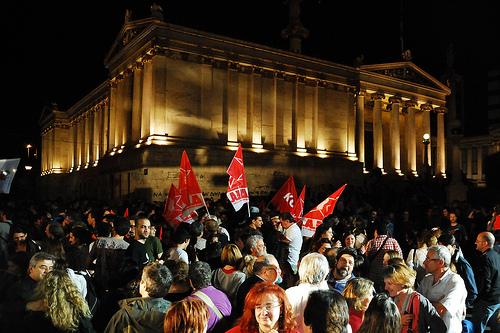
The metoric rise of the radical anti-austerity Syriza coalition was not enough to win the Greek elections. (Photo: Adolfo Cuartero/Flickr)
hase of the country’s economic collapse.
Greek voters gave European politicians a small window of opportunity to devise a credible plan to halt the downward spiral of bank insolvency and sovereign debt that’s afflicting much of Southern Europe. More likely, however, it has bought them a little more time to display even greater hubris. Thankfully, there’s plenty of insightful commentary that puts this in perspective.
Paul Krugman’s column in The New York Times is essential reading. Without shirking the fact that “there are big failings in Greece’s economy, its politics and no doubt its society,” he points out that all of these are “beside the point” because:
[T]he origins of this disaster lie farther north, in Brussels, Frankfurt and Berlin, where officials created a deeply — perhaps fatally — flawed monetary system, then compounded the problems of that system by substituting moralizing for analysis. And the solution to the crisis, if there is one, will have to come from the same places….The only way the euro might — might — be saved is if the Germans and the European Central Bank realize that they’re the ones who need to change their behavior, spending more and, yes, accepting higher inflation.
Larry Elliot, writing in The Guardian, also stresses the need for European and global policymakers to tackle “structural issues,” given that the Eurozone has fatally locked in “differences in productivity and competitiveness.”
A more detailed version of this analysis has been provided over the past few years by the Research on Money and Finance group, under the guidance of Costas Lapavitsas. He’s also featured in Monday’s Guardian, reminding readers that the Pyrrhic victory for pro-austerity parties in the Greek election prolongs the Eurozone’s structural failings, that are hitting southern Europe hard: “As long as Germany continues to keep its own wages stagnant, no country in the Eurozone can significantly gain competitiveness by reducing wages,” he writes, while reminding readers that delays in tackling structural issues have served mainly to shift responsibility for the crisis from private investors to the Greek people:
When the crisis burst out in 2010, Greece had €300bn of debt, held overwhelmingly by private creditors and governed by Greek law… by early 2012 Greek debt had risen to €370bn. Of that, however, only about €200bn remained in private hands. In less than two years, the EU had saddled Greece with a massive official debt, much of which had been used to retire old debt, allowing large private creditors to exit without losses.
His conclusion that the next “more complex and dangerous phase” will play out in Greece may not be correct, however. Spanish government bonds are taking a hammering, pushing the costs of servicing government debt (which, in turn, was mostly incurred by bailing out failed private investments) to unsustainable levels. The unwinding of the country’s recent bailout (which, as I live in Barcelona, I take no particular pleasure in having predicted) continues apace.
As the BBC’s Paul Mason points out,
“Spain can now go bust on its own timetable, instead of one dictated by a Greek exit from the euro. And then the problems begin….The over-arching problem is the severe social pain and disintegration austerity has brought to Greece: 22% unemployment; 1,000-euro one-off tax demands to pensioners; falling incomes, closing shops and bars; quiet motorways. Despair.”
A similar list could be reeled off for Spain.
All of this may seem far removed from the Rio+20 talks, but there’s actually not such a great distance between this and the “green economy” agenda that the EU is pushing here. “The EU is badly affected by a crisis of capital accumulation” explains Antonio Tricarico of Re:Common, an Italian-based organization challenging the financialization of nature. “There is a massive amount of private wealth, and few sufficiently profitable assets to invest in… so they’re creating new asset classes from which to extract more value.”
Or, at least, that’s what the EU wants to do. As I write, most of the meat has been stripped from its proposals to push new ecosystem services markets through the Rio+20 summit, and the EU is fuming.